Sustainable Lifestyle Diaries
From Rot to Riches

What Does “Organic” Really Mean? (Chemistry 101)
In chemistry, “organic” doesn’t mean pesticide-free – it means carbon-based. Organic molecules are built on carbon atoms bonded with hydrogen (and often oxygen, nitrogen, and more). They include the carbohydrates, proteins, fats, and nucleic acids that make up our bodies and all living things. Carbon is literally the backbone of life: about 45–50% of the dry mass of living organisms is carbon. Thanks to carbon’s knack for forming stable bonds (it has four bonding electrons ready to connect), it can build complex, diverse molecules – the stuff of cells, tissues, and energy.
In short, organic compounds are the essential building blocks of life, and their carbon-rich structure is what makes life on Earth possible. When we talk about composting “organic waste,” we mean all those carbon-based leftovers (like food scraps, paper, and yard trimmings) that once came from living organisms. Composting is our way of giving those carbon compounds back to the cycle of life.
Composting and the Cycles of Life: Biogeochemistry in Action
Life works in cycles. Consider the carbon and nutrient cycles: Plants pull carbon from the air and nutrients from the soil; animals eat the plants (and each other), then eventually everything that lived becomes raw material for the next generation. This magic is possible because of biogeochemical cycles – nature’s recycling systems that move elements like carbon, nitrogen, and phosphorus through the environment.
Composting supports these cycles by returning organic matter to the soil rather than trapping it in landfills. According to the U.S. EPA, when we send food and yard waste to a landfill, “we throw away the valuable nutrients and carbon contained in those materials.” Landfilling food essentially breaks the nutrient loop – those nutrients are lost from the ecosystem, sealed under layers of trash or burned up. Composting keeps the loop alive: we take yesterday’s banana peel or last week’s leaf pile and turn it into rich soil that feeds tomorrow’s plants.
By composting our scraps and using that compost, “we can return those nutrients and carbon to the soil to improve soil quality, support plant growth and build resilience in our local ecosystems.” In other words, composting closes the loop, keeping carbon and nutrients cycling through farms and gardens instead of languishing in a dump. It’s a local act with global impact, reinforcing the natural cycles that sustain life.
Meanwhile, landfilling organic waste doesn’t just remove nutrients from ecosystems – it actively harms them. In a landfill’s oxygen-starved environment, organic waste decays anaerobically and produces methane, a potent greenhouse gas, 4 times more potent than carbon dioxide. U.S. landfills are the third-largest source of human-related methane emissions, and food waste is the #1 contributor, causing about 58% of landfill methane.
Every apple core or pizza crust tossed in the trash is a missed chance to give nutrients back to the earth – and instead it’s fueling climate change. Composting flips that script: it uses aerobic decomposition (with oxygen), so instead of methane you get CO₂ (which plants recapture), and you lock much of the carbon into the soil as organic matter. Simply put, composting keeps carbon and nutrients in play, whereas landfilling pulls them out of the cycle and turns them into pollution.
Energy Flow and the Compost Connection: Feeding the Food Web
Energy in ecosystems flows in a one-way stream: sun → producers → consumers → decomposers. It starts with plants (producers) capturing sunlight to make food (biomass), which then feeds herbivores, which feed carnivores, and so on up the food chain. But at each step, energy is lost as heat – only about 10% of the energy at one trophic level makes it to the next level. That’s why food chains don’t go on forever; energy peters out.
However, what doesn’t disappear are nutrients. Enter the decomposers – the unsung heroes of the food web. Decomposers (like microbes, fungi, insects, and worms) occupy the last trophic level. They break down all the “leftovers” – dead plants, dead animals, and yes, your food scraps. In doing so, they recycle nutrients back into the ecosystem to be used again by plants. Without decomposers, nutrients would pile up in leaf litter and carcasses, unavailable to new life.
Composting is basically human-guided decomposition. It’s a way of recruiting trillions of decomposer organisms and giving them a big pile of buffet leftovers (our organic waste) in a controlled setting. In a compost heap, bacteria and fungi proliferate, feasting on banana peels and coffee grounds. Worms and bugs chew through leaves and eggshells. These decomposers break organic matter down into humus – a stable, nutrient-rich soil amendment. In ecological terms, composting extends the food web to our trash!
It ensures those last bits of energy and nutrients from our food are not wasted. Instead, they feed the decomposers, which in turn create the conditions for new producer growth. This supports the entire food web, from the microscopic soil biota up to the crops and forests that feed us and other animals. By composting, we mimic and reinforce nature’s own nutrient-recycling program, keeping the energy flowing and the cycle going strong.
Soil Health Is Earth’s Wealth: “Black Gold” and Why It Matters
Healthy soil is alive – teeming with microorganisms, rich in organic matter, and capable of holding water and nutrients like a sponge. Compost, often called “black gold” by farmers, is a treasure for soil health. When we add compost to soil, we’re doing more than disposing of waste; we’re supercharging the soil ecosystem. Compost adds crucial organic matter (remember those carbon-based compounds) that feeds soil microbes and improves soil structure.
According to the U.S. Fish & Wildlife Service, even a single compost application can boost soil microbial abundance by adding billions of beneficial microbes to the dirtf. Those microbes get to work cycling nutrients faster and more efficiently, which in turn benefits plant growth. In essence, compost brings soil to life, increasing its biodiversity and fertility.
Compost also dramatically improves the physical properties of soil. It binds with particles to create a crumbly structure that holds water like a sponge. This means better water retention – compost-rich soil can hold far more moisture, which helps plants through dry spells and reduces runoff in heavy rain.
The USDA has found that adding compost increases soil water holding capacity and can reduce erosion in drought-prone rangelands. By reducing soil compaction, compost helps water infiltrate the ground instead of puddling or eroding the surface.
This not only conserves water for plants, but also prevents pollution – rain running off bare, compacted soil tends to carry away fertilizers and sediment, but compost-amended soil keeps more of that water (and nutrients) where they belong.
Moreover, compost naturally contains a balanced buffet of nutrients – nitrogen, phosphorus, potassium, and trace minerals – that plants need to thrive. By returning these nutrients to the land, compost reduces the need for synthetic fertilizers. That’s a big deal, because chemical fertilizers can leach into groundwater or run off into rivers, causing environmental harm.
Compost releases nutrients slowly, like a time-release capsule, and soil life helps pass them to plants when needed. The result? Stronger, healthier plants with better yields and resilience. The EPA notes that using compost can improve plant growth and even help remediate degraded or contaminated soils. It’s like giving the land a nutrient-rich multivitamin and probiotic in one go.
Finally, healthy soil is a climate ally. Soils with high organic matter (thanks to compost) can sequester significant amounts of carbon – trapping it underground in stable forms. In fact, compost-amended soils have been shown to store far more carbon than poorly managed soils.
One long-term California study found that integrating compost into croplands increased soil carbon by 12.6% over 19 years, exceeding international carbon sequestration goals. How? Compost provides carbon for soil microbes along with vital nutrients, allowing them to build more organic matter rather than consume it.
As the EPA succinctly puts it, compost “sequesters carbon in the soil, helping reduce greenhouse gas emissions.” Every handful of compost you mix into your garden is literally pulling some carbon out of the air and locking it into the ground for years or decades. Healthier soil, happier plants, less atmospheric carbon – it’s a win-win-win for sustainability.
Climate Showdown: Landfilling vs. Composting Food Waste
When it comes to carbon footprints, not all waste disposal is created equal. Landfilling food waste is a climate disaster, while composting is a climate opportunity. The culprit is methane (CH₄). In an oxygen-poor landfill, organic matter breaks down anaerobically and generates methane gas. Methane may be invisible, but it packs a wallop: over a 100-year span, methane has 28–36 times the heat-trapping power of CO₂.
This means even a small amount of rotting food in a landfill can have a big warming impact. U.S. EPA data show landfills belch out methane equivalent to driving 66 million cars each year, and food waste is the single largest source of that methaner In 2022, landfills accounted for roughly 14% of all U.S. methane emissions– and remember, methane warms fast and furiously, contributing to near-term climate change.
Composting, by contrast, largely avoids methane. In a well-managed compost pile, decomposers have plenty of oxygen, so the process stays aerobic (and any minimal methane produced is quickly oxidized in the presence of air). Instead of methane, the carbon in your food waste is converted into CO₂ or locked into the finished compost as stable carbon compounds. CO₂ isn’t great in excess either, but it’s far less potent than methane and, critically, plants can reabsorb that carbon dioxide during photosynthesis. Composting also improves carbon sequestration in soils – effectively helping to offset emissions by storing carbon. The EPA confirms that composting not only prevents methane formation but also “lowers greenhouse gases by improving carbon sequestration in the soil."
What about the emissions from composting operations themselves? It’s true that composting isn’t emissions-free – there’s some CO₂ release as organic matter breaks down, and a small amount of nitrous oxide can be generated. But multiple life-cycle analyses have found that the net greenhouse gas emissions from composting are far lower than from landfilling the same materials. One reason is that composting avoids the methane that would have been emitted in a dump; another is that using compost can reduce the need for energy-intensive fertilizers and irrigation (since compost retains water and nutrients). In fact, using compost on land has a net carbon negative effect in some studies – meaning it ultimately removes more greenhouse gases (via soil carbon storage) than it emits.
To visualize it: imagine one ton of food scraps. Landfilled, it might produce tens of kg of methane, translating to hundreds of kg of CO₂-equivalent emissions. Composted, that same ton might emit a fraction of that in CO₂, while locking a significant portion of carbon into the soil for the long haul. Plus, composting yields a product that furthers climate goals by enriching soil and plant growth. This is why leading environmental groups and cities (from the NRDC to San Francisco) champion composting as a key climate action. San Francisco’s citywide composting program, for example, has helped the city divert 80% of its waste from landfills, avoiding about 90,000 metric tons of CO₂-equivalent annually.
The bottom line: if we want to cut the carbon footprint of our food waste, composting is the way to go. It turns a greenhouse gas emitter into a soil enhancer.
Nutrient Loading: Why You Shouldn’t Toss Apple Cores in the Woods
You might think, “Food is natural – why not just chuck it outside for the critters? It will biodegrade.” It’s true that food will decompose eventually, but throwing food scraps into wild spaces or waterways is not OK – it creates problems both for wildlife and the environment. One major issue is nutrient loading. Nutrient loading refers to an excess of nutrients (especially nitrogen and phosphorus) entering an ecosystem, often a water body. It’s basically fertilizer in the wrong place at the wrong time, and it can wreak havoc. The NOAA explains that when too many nutrients enter a lake, river, or ocean, they act like fertilizer and cause explosive algal growth (eutrophication).
Think pea-green ponds or giant algal “dead zones” in bays. As those algal blooms die off and rot, they consume oxygen, sometimes so much that the water becomes oxygen-depleted. Fish, shellfish, and other aquatic life suffocate in these low-oxygen “dead zones."
So what’s that got to do with tossing, say, a bag of old bread or a pile of pasta in the woods? Well, food waste is loaded with nitrogen and phosphorus – the same nutrients in fertilizers. When food rots in the wild, especially if near streams or lakes, those nutrients can leach or runoff into the water, contributing to nutrient pollution.
Even a small amount of food waste, multiplied by many people, can cause a big problem. You might have seen “Don’t Feed the Ducks” signs at parks – partly it’s to avoid habituating wildlife, but also because uneaten bread fouls the water, leading to algal growth and poor water quality. In a campground or along a trail, if everyone starts dumping “biodegradable” food, you could quickly create a nutrient hotspot that throws the local ecosystem out of balance.
That brings us to the other issue: wildlife disruption. Food scraps, even banana peels or apple cores, can attract animals in unnatural ways. If you throw food out of your car or leave it at a campsite, wild animals learn to associate those areas with an easy meal. This can lead to wildlife getting too close to humans (raccoons rifling through your campground, bears sniffing around tents – yikes!).
The National Park Service flatly advises: “Do NOT feed wildlife under any circumstances.” When animals get human food, they can become aggressive and persistently hang around campsites or roads. This isn’t healthy for the animals or safe for people. Even small critters like squirrels and birds can have their natural feeding habits altered. The Appalachian Trail Conservancy notes that “even a small amount of food scraps can attract wildlife,” and hundreds of hikers’ worth of tossed apple cores at a shelter can cause major issues. Wildlife drawn to human food can end up getting hit by cars, spreading disease in crowded feed areas, or suffering health problems from eating foods not in their natural diet.
In short: “organic” litter is still litter. Yes, a banana peel will decompose, but until it does, it can spoil the view, harm animals, and leach nutrients where they don’t belong. The proper way to handle food waste in nature is to pack it out – bring those peels and cores home to a compost bin rather than dumping them on the landscape. Nutrient loading and wildlife impacts are exactly the problems that organized composting is designed to prevent.
Closing the Loop in a Controlled Way: Composting to the Rescue
Composting offers a controlled environment to manage decomposition so that we reap the benefits and avoid the downsides. In a well-tended compost system (whether a backyard bin or an industrial facility), we keep the process contained. Nutrients are conserved in the compost – they bind into the humus and microbial biomass – instead of washing away into stormwater.
Good composters also manage moisture and airflow, preventing the liquid “leachate” that can cause nutrient runoff. (In fact, large composting facilities often collect any runoff water and cycle it back into the compost or treat it.) The goal is that when you apply the finished compost to soil, the nutrients are released slowly to plants, not dumped all at once into the environment. This is a world apart from tossing raw food waste on the ground. Composting essentially prevents nutrient pollution by keeping nutrients in a usable form until they can be safely returned to the soil as fertilizer.
By keeping food waste out of landfills and in compost piles, we also relieve pressure on waste treatment systems. It’s a proactive, upstream solution. The controlled setting of compost means we don’t get surprise methane leaks or contaminated leachate infiltrating groundwater – problems that landfills struggle with.
Additionally, composting and other organics recycling methods let us recover valuable resources: we get renewable soil amendments and even renewable energy (if using methods like anaerobic digestion) from our waste. It’s a key part of building a circular economy. As one sustainability expert put it, promoting composting “helps recover nutrients and energy, reducing reliance on synthetic fertilizers that can cause runoff." When cities set up curbside compost programs or when we compost at home, we’re ensuring that nutrients go back into gardens and farms in a measured way, not into our rivers and bays.
Finally, composting is intensely local and optimistic by nature. It takes a problem – smelly garbage – and turns it into an opportunity: local jobs in compost facilities, community gardens enriched with homemade compost, neighbors sharing excess produce grown in compost-fed soil. It empowers individuals and communities to make a tangible difference. Many U.S. states and municipalities are catching on, banning food waste from landfills and investing in compost infrastructure. From Massachusetts to California, policies now require large food generators to compost, spurring a boom in composting facilities and green jobs.
The best part? Everyone can participate, from sprawling cities to rural towns. Even if you don’t have a yard, composting programs (or worm bins for apartment dwellers) let you be part of the solution. Each apple peel or coffee ground you compost is a small act of rebellion against waste and a vote for regeneration.
In the grand scheme, composting is more than just a way to handle trash – it’s a statement about valuing our planet’s nutrient cycles and healing capacity. It says that we choose to work with nature’s genius instead of against it. We choose to feed the soil, not the landfill. We choose to protect our watersheds and wildlife by keeping nutrients where they belong. And in doing so, we’re cultivating hope (and some really awesome tomatoes!).
Composting shrinks our waste footprint and grows our environmental handprint. It’s humble and profound at the same time – a banana peel today, a flourishing garden tomorrow, a cooler climate for the future. Playfully bold, intensely passionate, fiercely optimistic – that’s the spirit of composting and the spirit driving a new era of sustainability. So let’s get out there and turn our rot into riches, one compost pile at a time.
Sources:
U.S. EPA – Composting is a form of organics recycling… When we send food and other organic materials to landfills or combustion facilities, we throw away the valuable nutrients and carbon contained in those materials. By composting… we can return those nutrients and carbon to the soilepa.gov. (EPA, Composting, updated 2023)
OpenStax Anatomy & Physiology – Organic compounds… contain both carbon and hydrogen. Carbon atoms in organic compounds readily share electrons with hydrogen and other atoms, usually oxygen…open.oregonstate.education. (J. Gordon Betts et al., 2nd ed., 2021)
Wikipedia – Carbon is the core element for all known forms of life… representing approximately 45–50% of all dry biomass.en.wikipedia.org. (Wikipedia, Carbon-based life, accessed 2025)
U.S. EPA – In the U.S., food is the single most common material sent to landfills… comprising 24.1% of municipal solid waste… When… organic materials decompose in a landfill (without oxygen)… they generate methane, a powerful greenhouse gas… Wasted food is responsible for 58% of landfill methane emissions.epa.govepa.gov. (EPA, Sustainable Management of Food: Composting, updated 2023)
NRDC – During anaerobic decomposition, biogas is roughly 50% methane and 50% carbon dioxide, both of which are potent greenhouse gases, with methane being 28 to 36 times more effective than CO₂ at trapping heat in the atmospherenrdc.org. (NRDC, Composting 101, 2020)
National Geographic – On average only 10 percent of energy available at one trophic level is passed on to the next.education.nationalgeographic.org (NatGeo Education, Energy Flow and the 10% Rule, 2023)
Biology Online – Decomposers occupy the last trophic level… They break down the organic matter of dead organisms where a part of it returns to earth as a geochemical component. The role of decomposers in the ecosystem is vital.biologyonline.com. (BiologyOnline.com, Trophic level, accessed 2025)
U.S. FWS – Compost additions show promise in supporting many aspects of rangeland ecosystem function, including increasing plant productivity and soil water retention… even a single application of compost can provide a range of benefits, including increased soil carbon and soil water holding capacity. Compost… [adds] billions of microbes. Increased soil microbe abundance can lead to increased nutrient and carbon cycling, benefitting plant growth.fws.govfws.gov. (US FWS, Benefits of Compost for Rangeland Plant and Soil Health, 2023)
U.S. EPA – Compost enriches and builds healthy soil: adds organic matter… increases the nutrient content and biodiversity of soil microbes; conserves water by helping soils retain moisture; helps prevent soil erosion by reducing compaction and runoff; reduces reliance on chemical fertilizers…epa.gov. Compost increases adaptation and resilience: sequesters carbon in the soil, helping reduce greenhouse gas emissions.epa.gov. (EPA, Composting – Benefits of Using Compost, 2025)
UC Davis – When both compost and cover crops were added in an organic system, soil carbon content increased 12.6% over 19 years (~0.7% annually)… Compost provides not only carbon but also additional vital nutrients for microbes to function effectively… “One reason we keep losing organic matter from soils is that our focus is on feeding the plant, and we forget… to feed the soil.”ucdavis.eduucdavis.edu. (UC Davis, Compost Key to Sequestering Carbon in the Soil, 2019)
RMI – Landfills are the third largest source of methane in the United States with annual emissions equivalent to driving 66 million cars… Methane is generated when organic materials – such as food waste, yard waste, and paper – decompose in landfills without oxygen. Food waste is the single most landfilled material, causing nearly 60% of landfill methane emissions.rmi.org. (Rocky Mountain Institute, 2023)
Sustainability Directory – Food waste contains high levels of nutrients, particularly nitrogen and phosphorus. When these nutrients enter water bodies, they can cause eutrophication… excessive growth of algae… As these organisms die and decompose, bacteria consume large amounts of dissolved oxygen… creating ‘dead zones’ where aquatic life cannot survive.pollution.sustainability-directory.com. (Sustainability Directory Q&A, Food Waste & Water Pollution, 2025)
Appalachian Trail Conservancy – “Pack it in, pack it out” includes compostable food scraps. Apple cores, orange peels, etc. should be packed out. Even a small amount of food scraps can attract wildlife, but several hundred hikers’ worth… really starts to cause big problems.appalachiantrail.org. (ATC, Leave No Trace Tips, 2022)
U.S. NOAA – Nutrient pollution is the process where too many nutrients, mainly nitrogen and phosphorus, are added to bodies of water and can act like fertilizer, causing excessive growth of algae… leading to low levels of oxygen in the water that can kill fish and other aquatic animals.oceanservice.noaa.govoceanservice.noaa.gov. (NOAA, What is nutrient pollution?, 2024)
Sustainability Directory – Promoting composting and anaerobic digestion helps recover nutrients and energy, reducing reliance on synthetic fertilizers that can cause runoff.pollution.sustainability-directory.com. (Sustainability Directory Q&A, Food Waste & Water Pollution, 2025)
The Missing Mountain of Meat: We Turned Death into a Climate Problem

We Turned Death Into A Climate Problem
Somewhere, an ecologist is looking at our funeral industry and quietly screaming (spoiler - it's me).
Every year, about 62 million humans die worldwide.
The average adult body mass globally is about 62 kilograms.
Do the math and you get roughly:
3.8 billion kilograms of freshly-minted human biomass
≈ 3.8 million metric tons of potential food for soils, fungi, worms, beetles, and scavengers… every single year.
Layer on top of that millions of pets: dogs, cats, and other beloved fluffballs. One estimate, combining U.S. pet-loss data with industry numbers, suggests 4.5+ million pets are cremated each year in the U.S. alone, contributing heavily to global cremation emissions.
Now take this mountain of nutrient-dense bodies and ask:
“How much of this ends up feeding ecosystems…
and how much becomes smoke, concrete, and lawn?”
Short answer: we’re leaking a ridiculous amount of organic wealth out of the planet’s life-support systems and turning death into a quiet climate liability.
A single human cremation typically releases around 400 kg of CO₂.
Pet cremations vary, but one review pegs them at roughly 80–230 pounds of CO₂ per animal, averaging about 155 pounds (~70 kg).
Death is inevitable.
The way we handle it? That’s policy, culture, and consumer choice.
The Great Biomass Heist: How We Broke The Energy Pyramid
Quick refresher: life runs on a very unglamorous, very real energy pyramid.
Producers are the base: plants, algae, photosynthetic microbes. They turn sunlight into sugars and biomass.
Consumers eat plants (herbivores), then each other (carnivores, omnivores) as you go up the steps.
Decomposers & detritivores (fungi, bacteria, worms, beetles, maggots) feast on dead stuff and poop, shredding it back into nutrients plants can reuse.
The rude physics:
On average, only about 10% of the energy at one trophic level becomes biomass at the next. The rest gets burned off as heat, motion, and daily life.
That means dead bodies and waste are not a side quest; they’re a major nutrient delivery system.
Detritus is a huge chunk of ecosystem organic material.
When we:
Lock bodies in embalmed, metal-lined caskets inside concrete vaults, or
Blast them at high temperature in fossil-fuel crematoria,
we’re effectively:
“Stealing from fungi and worms, tipping the plate into the sky, and then wondering why our soils are tired.”
In energy-pyramid terms, we’re interrupting that massive decomposer loop that takes detritus and recycles it back into plant-available nutrients.
Control Group: The Default Funeral Is An Ecological Crime Scene
1. Conventional embalmed burial: “Forever Chemicals & Lawn Maintenance”
The “standard” North American / European setup often looks like:
Embalming with formaldehyde-based chemicals
Metal or hardwood casket
Concrete or metal burial vault
Cemetery managed like a golf course: mowed grass, pesticides, irrigation
Environmental hits:
Use of tons of metal, hardwood, and concrete for burial vaults and caskets every year.
Embalming fluids can eventually leach into soil and groundwater.
Land locked into low-biodiversity turf.
We take a body that could become mushrooms, soil, and wildflowers and instead turn it into an underground museum exhibit.
2. Flame cremation: “Road Trip To The Atmosphere”
Cremation solves the land-use issue but trades it for emissions:
Each human cremation averages around 400 kg of CO₂, plus other pollutants (mercury from fillings, NOx, etc.).
Scale that across millions of deaths a year and you’re looking at hundreds of thousands of tons of CO₂ annually from human cremation alone, plus a growing slice from pets.
We’ve basically invented fossil-fueled decomposition.
Nature: “I can do this with bacteria and beetles.”
Us: “No thanks, I brought propane.”
Better Human Afterlives: From Vault Resident To Ecosystem Employee
Now for the fun part: less awful and sometimes downright beautiful alternatives.
1. Green / Natural Burial: “Compostable Human Packaging”
What it is:
No embalming
Simple biodegradable shroud or casket
No concrete vault
Graves in more natural landscapes (meadow, woodland, conservation area)
Definition-wise, green burial means full-body burial without toxic embalming, vaults, or non-biodegradable caskets.
Where it’s legal:
In much of the U.S. and many other countries, this is legal as long as a cemetery offers it.
There are dedicated natural and conservation cemeteries certified by organizations like the Green Burial Council.
Ecologically, this is the “back to the food web” default: your body feeds microbes, plants, and the local food chain directly.
2. Human composting / Natural Organic Reduction: “VIP Express Lane To Topsoil”
What it is:
Your body goes into a vessel with materials like wood chips, straw, and alfalfa. Warm air and controlled moisture let microbes work their magic. After about a month or so plus curing time, you become rich soil that can nourish forests or restoration sites.
Where it’s legal (U.S.)
As of 2024–2025, human composting is legal in a growing list of states, including:
Washington, Colorado, Oregon, Vermont
California, New York, Nevada
Arizona, Maryland, Delaware, Minnesota, Maine
…and others as legislation spreads.
Impact-wise, it:
Uses much less energy than cremation
Returns carbon and nutrients straight to soil instead of the sky
3. Aquamation (Alkaline Hydrolysis): “Gentle Stew, Lower CO₂”
What it is:
The body is placed in a pressurized vessel with water and alkali. Moderate heat and time break tissues down into a sterile liquid and bone fragments.
No flame
Less energy use
No stack emissions from combustion
Where it’s legal (U.S.)
Alkaline hydrolysis is now legal in about 28 states, though not all have active providers yet.
Families then receive cremation-like remains; the liquid portion is treated like wastewater or, in some places, used beneficially in agriculture.
4. Donation To Science & The Body Farm Cameo
Medical & research donation:
Bodies go to medical schools, surgical training, or research.
After use, remains are usually cremated and returned or buried respectfully.
Forensic “body farms”:
Example: the Forensic Anthropology Research Facility (FARF) at Texas State University’s Freeman Ranch near San Marcos, Texas. It’s a 26-acre outdoor human decomposition research lab, one of the largest “body farms” in the world.
These facilities place donated bodies outdoors to study decomposition in real conditions, helping investigators estimate time since death and solve crimes.
Ecologically, your body:
Feeds insects, microbes, plants, and scavengers
Helps scientists understand how landscapes and scavengers interact with remains
You literally become crime-scene data + ecosystem buffet.
5. Sky Burial: “The Vulture Buffet We’re Not Invited To”
Sky burial is a traditional practice in parts of Tibet, Nepal, Bhutan, Mongolia, and regions of India, where bodies are ritually prepared and offered to vultures and other scavengers at designated charnel grounds.
Ecologically, it’s incredibly efficient: your biomass goes straight into scavenger bellies and then back into the nutrient cycle.
But it’s:
Tied to Vajrayana Buddhist beliefs,
Heavily regulated, and
Generally not accessible to non-local outsiders.
This belongs in your blog as a “respectful awe” example, not a travel hack.
Designer Ecologies: Reef Brains, Mushroom Suits & Conservation Cemeteries
Here’s the fun “I want to become habitat” menu, with legal context.
1. Reef Memorials: “Become Fish Real Estate”
Companies like Eternal Reefs in the U.S. and Resting Reef in the UK turn cremated remains into reef-style memorials:
Ashes are mixed with reef-safe materials (like concrete and crushed shells) to make reef modules that are placed on approved seabeds, where they provide habitat for fish, invertebrates, and corals.
Where it’s legal / how it works:
In the United States, burial at sea of cremated remains is allowed under a general permit, as long as it’s at least 3 nautical miles offshore and follows Environmental Protection Agency (EPA) guidelines.
Reef memorial companies operate within those rules and obtain specific site permits for their artificial reefs (e.g., designated locations off Florida and other coasts).
In places like the UK and pilot sites abroad (e.g., projects in or near Bali), memorial reefs are placed where local environmental regulators grant permits.
So legally, these services work where cremation is legal (which is almost everywhere) and where local authorities have approved artificial reef deployment.
2. Mushroom Coffins & Mycelium Suits: “Feed The Fungi”
The Loop Living Cocoon™, developed in the Netherlands, is a coffin grown from mycelium (the root-like network of fungi) and hemp fibers. It biodegrades rapidly and enriches soil.
The first U.S. burial using this type of mushroom coffin was reported in Maine, indicating that U.S. cemeteries can accept them where their regulations allow biodegradable containers and green burial.
Where it’s legal:
In the Netherlands, mycelium coffins are used in cemeteries that allow natural burial containers.
In the U.S., they’re generally legal wherever green or natural burial is permitted and the cemetery approves biodegradable caskets (no extra vault, no embalming). Green burial standards explicitly support biodegradable coffins and shrouds.
Short version: if a cemetery offers green burial, a mushroom coffin is usually just a very cool flavor of “plain biodegradable box.”
3. Conservation Burial Grounds: “Donate Your Body To A Nature Preserve”
Conservation burial is natural burial on protected conservation land:
No embalming
No vaults or metal/hardwood caskets
Burial density kept low
Land permanently conserved via land trusts or easements
Profits often help fund ongoing conservation management
The Green Burial Council certifies conservation burial grounds that meet strict standards for natural burial and land protection.
Where it’s legal:
In the U.S., there are multiple conservation cemeteries (like Prairie Creek Conservation Cemetery in Florida and others across several states), with more in development.
Other countries are experimenting with similar models wherever burial law and conservation easements play nicely together.
This is the closest thing to:
“Your body becomes a permanent donation to biodiversity + a tax-deductible land project.”
What About Fluffy? Sustainable Pet Afterlives
We can’t talk human biomass and ignore the couch-goblin who watched you write your will.
The default: Pet cremation
Traditional pet cremation (flame-based) is the standard in many vet clinics.
Estimates for emissions range from 80–230 lbs of CO₂ per animal, with ~155 lbs (~70 kg) often used as a working average.
With millions of pets cremated yearly in the U.S., the climate impact is… non-trivial.
Greener options for pets (where available)
Pet aquamation Uses the same alkaline hydrolysis process as human aquamation, but scaled for animals. Lower energy and emissions; some providers market it explicitly as an eco-option.
Pet green burial
Pet cemeteries or dedicated sections of human cemeteries that allow biodegradable shrouds/boxes and no vault.
In some regions, backyard burial of small pets is legal with restrictions (depth, distance from wells/streams); in others, it’s not. Local rules vary a lot, so this is a “check your municipality” situation.
Pet composting / farm programs
Some animal composting facilities (especially for livestock) and a few specialized services accept pets, turning remains into soil used for non-food trees or restoration.
Extremely location-dependent and heavily regulated.
Donation to science or wildlife centers
Vet schools may accept certain animals for training or pathology.
Some wildlife rehab centers may use carcasses to feed carnivores, where allowed.
Again: very case- and jurisdiction-specific.
The pattern: wherever green human options exist, parallel pet options tend to emerge.
“Afterlife Budgeting”: Voting With Your Death Dollars
We already vote with our dollars on food, fashion, banking, and energy.
The funeral industry is just another supply chain with defaults shaped by culture and profit, not necessarily by ecology.
“Our last big purchase is also a vote.
We can buy a steel box, a concrete bunker, and a fossil-fuel flamethrower…
or we can buy time for forests, reefs, fungi, vultures, and future humans.”
What you can do:
Put green burial, composting, aquamation, or conservation burial in your advance directives if they’re available where you live.
Ask local funeral homes what eco-options they offer. If they say “none,” that’s information.
If you donate to nonprofits, add land trusts, conservation cemeteries, reef and restoration projects to your list.
For pets, ask your vet about aquamation or green burial options, not just default cremation.
“If every dollar is a vote, then every final invoice is a ballot too.
We can either fund more marble and emissions…
or we can feed a forest, grow a reef, or teach a forensic scientist how vultures recycle us.
Personally, I’m team ‘turn me into habitat.’” 🪦🌿
Sources & Further Reading
Our World in Data – Global annual deaths (~62 million/year)
https://ourworldindata.org/mortality-risk
https://en.wikipedia.org/wiki/List_of_causes_of_death_by_rate
Walpole et al., “The weight of nations: an estimation of adult human biomass” – Global average adult mass ~62 kg
https://www.ncbi.nlm.nih.gov/pmc/articles/PMC3757964/
https://www.livescience.com/42124-average-human-weight.html
National Geographic & Khan Academy – 10% rule and trophic energy flow
https://education.nationalgeographic.org/resource/energy-pyramid
https://www.khanacademy.org/science/biology/ecology/energy-flow-through-ecosystems/a/energy-flow-through-ecosystems
https://en.wikipedia.org/wiki/Ecological_pyramid
LibreTexts & Britannica – Trophic pyramids, biomass, and decomposers
https://bio.libretexts.org/Bookshelves/Ecology/Book%3A_Ecology_(Krebs)/02%3A_Ecosystems/2.04%3A_Trophic_Pyramids
https://www.britannica.com/science/ecological-pyramid
https://en.wikipedia.org/wiki/Trophic_level
Green Burial Council & related docs – Definitions of green and conservation burial
https://www.greenburialcouncil.org/
https://highergroundburial.com/
https://nfda.org/
Better Place Forests, Phaneuf, and Earth Funeral – Human composting legal states and status
https://betterplaceforests.com/
https://earthfuneral.com/
(Phaneuf reference: no direct link available; may refer to industry reports or articles)
WorldPopulationReview, NFDA, and US-Funerals – Aquamation legal in ~28 U.S. states
https://worldpopulationreview.com/state-rankings/aquamation-legal-states
https://nfda.org/
https://us-funerals.com/
National Geographic / Guardian / Funeral industry blogs – Cremation emitting ~400 kg CO₂ per body
https://www.nationalgeographic.com/environment/article/cremation-carbon-footprint
https://www.theguardian.com/environment/2021/jan/07/cremation-carbon-emissions-climate-change
https://highlandlakescremation.com/
https://serenityridgefuneralhome.com/
https://blog.davisstruempf.com/
Eternal Reefs & Resting Reef – Reef memorials with cremated ashes; site-specific permits
https://restingreef.com/
https://eternalreefs.com/
U.S. EPA – Burial at sea rules for cremated remains (3+ nautical miles offshore)
https://www.epa.gov/ocean-dumping/burial-sea-guidelines
Loop Biotech & Ecowatch – Mycelium coffin (Loop Living Cocoon), Netherlands origin and first U.S. burial in Maine
https://loopbiotech.com/
https://www.ecowatch.com/mycelium-coffin-2650188006.html
Forensic Anthropology Research Facility at Texas State (Freeman Ranch body farm)
https://www.texastribune.org/2019/10/22/body-farm-texas-state-university/
https://www.txstate.edu/anthropology/facilities/freeman-ranch.html
https://en.wikipedia.org/wiki/Body_farm
Tibetan sky burial & regional practice
https://en.wikipedia.org/wiki/Sky_burial
https://www.tibettravel.org/tibet-travel-guide/tibetan-sky-burial.html
Pet cremation CO₂ estimates and global cremation emissions
https://www4.des.state.nh.us/
https://eternaltidesfmwf.com/
https://tranquiltidespetcremation.com/
If We Healed the Ozone Hole, We Can Still Change the Climate

In the 1980s, scientists basically told the world:
“We’ve punched a hole in the planet’s sunscreen.”
The ozone hole over Antarctica was growing. Skin cancer risks were rising. And the cause wasn’t villains in capes, it was… hairspray, refrigerators, and air conditioners.
Then something rare and beautiful happened:
Countries listened. Corporations changed their products. Rich nations helped poorer ones. Nearly every government on Earth signed one agreement and stuck to it.
That agreement was the Montreal Protocol, and it is proof that global cooperation can literally change the chemistry of the sky in our favor.
Now we’re facing a different crisis: global warming. Harder, messier, more deeply wired into everything. But the ozone story shows that when we act together, big systems do move.
Let’s explore:
How CFCs tore open the ozone layer
Why ozone is “good up high, bad nearby”
How the Montreal Protocol worked and what replaced CFCs
How this is different from global warming
How combustion engines create smog-level ozone
Why EVs are already cleaning the air in measurable ways
And how Montreal is a blueprint for the climate fight
1. Ozone 101: good up high, bad nearby
Ozone is just three oxygen atoms: O₃. Same molecule, two very different personalities depending on altitude.
Stratospheric ozone: the planet’s sunscreen
In the stratosphere, about 15–35 km above us, ozone forms a thin layer that absorbs harmful ultraviolet (UV) radiation from the Sun. Without it, more UV-B and UV-C reach the surface, increasing skin cancer, cataracts, and damage to crops and marine life.
Up there, ozone is good. It is the shield.
Tropospheric ozone: the lung-burner
Near the ground, in the troposphere, ozone is formed as a pollutant. It’s a key ingredient in photochemical smog and:
Irritates lungs
Triggers asthma attacks
Reduces crop yields and harms vegetation
Down here, ozone is bad. Same molecule, wrong place.
So the rule of thumb:
Ozone up high: essential.
Ozone nearby: harmful.
The ozone crisis was about destroying the good ozone up high. Smog is about creating too much bad ozone down low.
2. How CFCs broke the sky
The main villains of the ozone story are chlorofluorocarbons (CFCs). They were designed to be miracle chemicals: stable, non-flammable, and great for cooling and sprays.
They were used in:
Refrigerators and freezers
Air conditioners
Spray-can propellants
Foam blowing agents for insulation
That stability is exactly why they were dangerous.
CFCs released at the surface drift up into the stratosphere over years.
Up there, intense UV radiation breaks them apart.
This releases chlorine atoms (Cl), which act as catalysts in ozone-destroying cycles.
A simplified catalytic cycle:
Cl + O₃ → ClO + O₂
ClO + O → Cl + O₂
Net reaction: O₃ + O → 2 O₂
The chlorine atom is regenerated, so one chlorine atom can destroy thousands of ozone molecules before being removed.
By the mid-1980s, satellite and ground-based measurements showed a huge seasonal “ozone hole” over Antarctica, appearing each Southern Hemisphere spring. This wasn’t a tiny dip; it was a massive thinning of the protective layer.
3. The Montreal Protocol: when the world actually cooperated
In 1987, countries agreed to the Montreal Protocol on Substances that Deplete the Ozone Layer. It entered into force in 1989 and is now ratified by essentially every nation on Earth.
Key features:
Phase-out of nearly 99% of controlled ozone-depleting substances (ODS) like major CFCs and halons
Legally binding schedules to reduce and then eliminate production and consumption
A Multilateral Fund so wealthy nations help finance transitions in developing countries
Regular scientific assessments and amendments as new evidence came in
And it worked. Hard.
Recent NOAA–NASA and UN assessments show:
Concentrations of major ODS in the atmosphere have peaked and are declining
The ozone layer is recovering, with notable improvement in the upper stratosphere
The Antarctic ozone hole is trending smaller and shorter-lived on average, even though volcanic eruptions and climate variability still cause year-to-year swings
Best current estimates:
Mid-latitude ozone back to 1980 levels around the 2040s
Antarctic ozone back to 1980 levels around 2066, if compliance continues
And here’s the bonus twist:
CFCs are also powerful greenhouse gases. By phasing them out, the Montreal Protocol has:
Already prevented emissions equivalent to tens of billions of tons of CO₂
Likely avoided about 0.5–1.0 °C of additional warming by 2100 when you include both direct CFC warming and damage they would have done to the carbon sink via extra UV
So yes: one treaty helped heal the ozone layer and reduced future global warming at the same time.
4. What replaced CFCs – and what we use today
The world didn’t just “stop cooling things.” Montreal forced an evolution in refrigerants:
CFCs → HCFCs → HFCs → low-GWP & “natural” refrigerants
Step 1: HCFCs – the “less bad” bridge
First came HCFCs (hydrochlorofluorocarbons):
Still contain chlorine, so they do deplete ozone, but less than CFCs
Still strong greenhouse gases with high global warming potential (GWP)
They were widely used in:
Home and commercial refrigeration
Air conditioning and chillers
Foam blowing
Some aerosols/solvents
The Montreal Protocol treated HCFCs as temporary:
Developed countries phased them out by around 2020
Developing countries are phasing them out by around 2030, with limited servicing allowances
Step 2: HFCs – fixed the ozone, hit the climate
Next came HFCs (hydrofluorocarbons):
No chlorine, so no ozone depletion
But many have very high GWP, hundreds to thousands of times CO₂
HFCs exploded in use:
Most modern fridges and freezers (until recently)
Car air conditioning (R-134a, now being replaced by low-GWP HFO-1234yf)
Building chillers and split A/C units
Foam insulation
Some aerosols and fire suppression systems
They solved the ozone problem, while quietly becoming a fast-growing source of climate warming. Under a high-use scenario, HFCs alone could have added up to 0.4–0.5 °C of warming by 2100.
Enter…
Step 3: Kigali Amendment – taking on HFCs
In 2016, countries adopted the Kigali Amendment to the Montreal Protocol to phase down HFCs globally. It entered into force in 2019 and now has more than 160 parties.
If fully implemented, Kigali is expected to:
Cut HFC use by over 80% in coming decades
Avoid up to ~0.4–0.5 °C of warming by 2100
Same treaty, upgraded mission:
First save the ozone layer, now help save the climate too.
Step 4: Today’s trend – “natural” and low-GWP refrigerants
Right now, we’re shifting toward refrigerants that protect both ozone and climate:
“Natural” refrigerants:
CO₂ (R-744)
Used in supermarket systems, some heat pumps and vending machines
Ozone depletion potential (ODP) = 0, GWP = 1 by definition
Ammonia (R-717)
Common in large industrial refrigeration
Zero ODP, very low GWP, but toxic if leaked, so used in carefully engineered systems
Hydrocarbons (propane R-290, isobutane R-600a, etc.)
Now widely used in household refrigerators, small commercial units, and some A/C
Zero ODP and very low GWP (~3), but flammable, so charge sizes and safety codes matter
Many new fridges around the world now use isobutane (R-600a) instead of HFCs.
HFOs and low-GWP synthetics:
HFOs (hydrofluoroolefins) are designed to have very low GWPs and short atmospheric lifetimes
They appear in:
New car A/C systems (HFO-1234yf)
Newer chillers and commercial A/C
Foam blowing and other specialty applications
The U.S. EPA’s SNAP program (Significant New Alternatives Policy) and similar efforts in the EU actively evaluate and list acceptable substitutes, steering industry away from both ozone-depleting and high-GWP options.
So the arc looks like this:
CFCs (destroy ozone, warm the planet)
→ HCFCs (less ozone damage, still high GWP, transitional)
→ HFCs (no ozone damage, big warming)
→ CO₂, ammonia, hydrocarbons, HFOs (no ozone damage, much lower warming)
We have literally redesigned global cooling technology three times based on atmospheric science.
That’s not nothing.
5. Ozone depletion vs global warming: same sky, different story
It’s tempting to say “We fixed the ozone hole, so we can fix global warming the same way.”
Yes… and also not exactly.
Ozone depletion:
Mainly caused by a relatively small group of chemicals (CFCs, halons, some HCFCs)
Mostly used in a handful of sectors (refrigeration, A/C, aerosols, foams, solvents)
Chemistry is focused in the stratosphere
Impacts: UV increase, skin cancer, cataracts, ecosystem damage
Global warming:
Driven primarily by CO₂, methane, nitrous oxide, and other greenhouse gases
Emitted through almost everything: energy, transport, industry, agriculture, land use
Acts through infrared absorption throughout the atmosphere
So the ozone problem was narrower and more “surgical”: you could target specific chemicals and industries.
Climate change is more like rewiring the whole energy and land system.
But the Montreal playbook still matters:
Listen to scientists
Set binding global limits
Build fairness into the deal
Fund technology transitions
Update agreements as science evolves
We are doing this, just unevenly: think Paris Agreement, national climate laws, and regional fossil phase-out plans. The question is whether we’ll move fast enough.
6. Ground-level ozone: how engines cook smog out of thin air
Now let’s come back down from the stratosphere to the air we actually breathe.
Tropospheric (ground-level) ozone is not emitted directly. It is created by sunlight-driven chemistry from precursor pollutants:
NOₓ: nitrogen oxides (NO and NO₂), mostly from combustion
VOCs: volatile organic compounds, from fuel vapors, solvents, industry, and vehicles
Sunlight
The U.S. EPA and atmospheric chemistry texts summarize the core steps like this:
Combustion in engines emits NO and NO₂ (collectively NOₓ) plus VOCs.
In sunlight, NO₂ splits:
NO₂ + hv (sunlight) → NO + O
The free O atom reacts with O₂:
O + O₂ + M → O₃ + M
(M is any third body that carries away extra energy.)
VOCs are oxidized to peroxy radicals (RO₂·) that react with NO:
RO₂· + NO → RO· + NO₂
This regenerates NO₂ without destroying ozone, allowing O₃ to accumulate.
In short:
NOₓ + VOCs + sunlight = ozone (O₃) + smog.
Cars, trucks, and buses are prime sources of those precursors, alongside power plants and industry.
Ground-level ozone is both:
A major health pollutant
A short-lived climate pollutant, contributing to warming on weekly-to-monthly timescales
So if we clean up combustion engines, we don’t just make air easier to breathe. We also chip away at near-term warming.
7. EVs: turning off the tailpipe chemistry set
Enter electric vehicles (EVs).
They don’t magically fix everything, but they do one extremely important thing:
They remove tailpipe NOₓ and VOC emissions where people live and breathe.
According to the U.S. Department of Energy’s Alternative Fuels Data Center and the EPA:
All-electric vehicles have zero tailpipe emissions
Plug-in hybrids have zero tailpipe emissions when running in electric mode
Even counting power plant emissions, EVs typically produce lower overall greenhouse gas emissions than comparable gasoline vehicles, especially as grids get cleaner
Real-world evidence: cleaner air, fewer asthma attacks
A study led by researchers at USC looked at California zip codes between 2013 and 2019, tracking zero-emission vehicle (ZEV) adoption, air pollution, and health outcomes:
For every additional 20 ZEVs per 1,000 people, there was:
A 3.2% drop in asthma-related emergency visits
A measurable reduction in NO₂ levels, a traffic-related pollutant linked to asthma and heart disease
Other modeling and health studies show that widespread EV adoption:
Cuts NOₓ, VOCs, and ozone in many regions
Reduces PM₂.₅ (fine particulates) when combined with cleaner power generation
Delivers the greatest benefits in communities packed near highways and busy roads
Are EVs perfect? No. They still depend on the grid mix, and non-exhaust emissions like tire and brake dust remain
issues. But in terms of the ozone-creating chemistry in city streets, EVs are a huge step forward.
They are, in a very literal sense, anti-smog machines.
8. What the Montreal story teaches us about climate
The Montreal Protocol shows that:
Science can ring the alarm
Clear evidence about CFCs and ozone forced a global reckoning.
The world can agree on strict rules
Montreal is one of the most universally ratified treaties in history, with real teeth.
Equity can be built in
The Multilateral Fund helped developing countries leapfrog to new technologies.
Industries can pivot fast under pressure
We’ve already re-engineered global cooling three times, and are now moving toward climate-friendly refrigerants.
We can literally change atmospheric trends
Ozone-depleting substances are declining. The ozone layer is healing. And we’ve already avoided substantial future warming from CFCs and HFCs.Now we stand in front of the climate problem, which is bigger and gnarlier but built on the same physics: molecules in the sky trapping energy.
To “do a Montreal” for climate, we need the same ingredients, scaled up:
Fast phase-down of fossil fuels, like we phased down CFCs and now HFCs
Global agreements with real schedules, like Paris, strengthened with clear fossil phase-out timelines
Massive investment in alternatives: renewables, storage, efficiency, EVs, heat pumps, natural refrigerants
Fairness and finance so Global South countries can develop without repeating the North’s fossil addiction
The ozone story is not a fairy tale. It is a technical, legal, and political precedent.
We already have proof that when humanity decides to cooperate, we can:
Stop selling harmful chemicals
Redesign huge industrial systems
Watch the atmosphere respond
And in the process, avoid degrees of global heating
The ozone layer is on a recovery trajectory right now, with the 2025 Antarctic ozone hole ranked among the smallest since the early 1990s.
If we can do that for a layer of gas 20 km overhead, we can absolutely change the trajectory of the whole climate system below it.
The question isn’t “Is it possible?”
Montreal already answered that.
The question is: Will we choose to cooperate at that scale again, this time for carbon?
Sources & Further Reading
UNEP – Ozone layer recovery on track, avoiding ~0.5 °C of warming UNEP - UN Environment Programme
NOAA 2022 Scientific Assessment of Ozone Depletion – climate benefits of Montreal Protocol NOAA Chemical Sciences Laboratory+1
Montreal Protocol overview & Kigali Amendment (Wikipedia) Wikipedia+1
CFC chemistry and ozone destruction (LibreTexts / chemistry of ozone depletion) Chemistry LibreTexts
Recent ozone hole trends and recovery (NOAA–NASA / news coverage) The Guardian+1
Ground-level ozone basics & health impacts (U.S. EPA) US EPA+1
Tropospheric ozone formation and chemistry (ground-level ozone article & teaching resources) Wikipedia+1
International HFC phase-down & Kigali climate benefits DCCEEW+2California Air Resources Board+2
CFC replacements: HCFCs, HFCs, and natural refrigerants (CFC article & technical guides) Climate Action+5Wikipedia+5Danfoss+5
EPA SNAP program – evaluating substitutes for ozone-depleting substances and high-GWP gases US EPA+3US EPA+3Wikipedia+3
USC / California ZEV study – EVs, NO₂, and asthma ER visits Keck School of Medicine of USC+2PMC+2
DOE Alternative Fuels Data Center & EPA – EV emissions and zero tailpipe pollutants Alternative Fuels Data Center+3Alternative Fuels Data Center+3Alternative Fuels Data Center+3
EVs, air quality, and climate modeling (NREL / Joint Office / policy analyses) Department of Transportation+2DCCEEW+2
Teflon Pans, "Forever Chemicals," and Your Kitchen
What You Need To Know (And What To Use Instead)
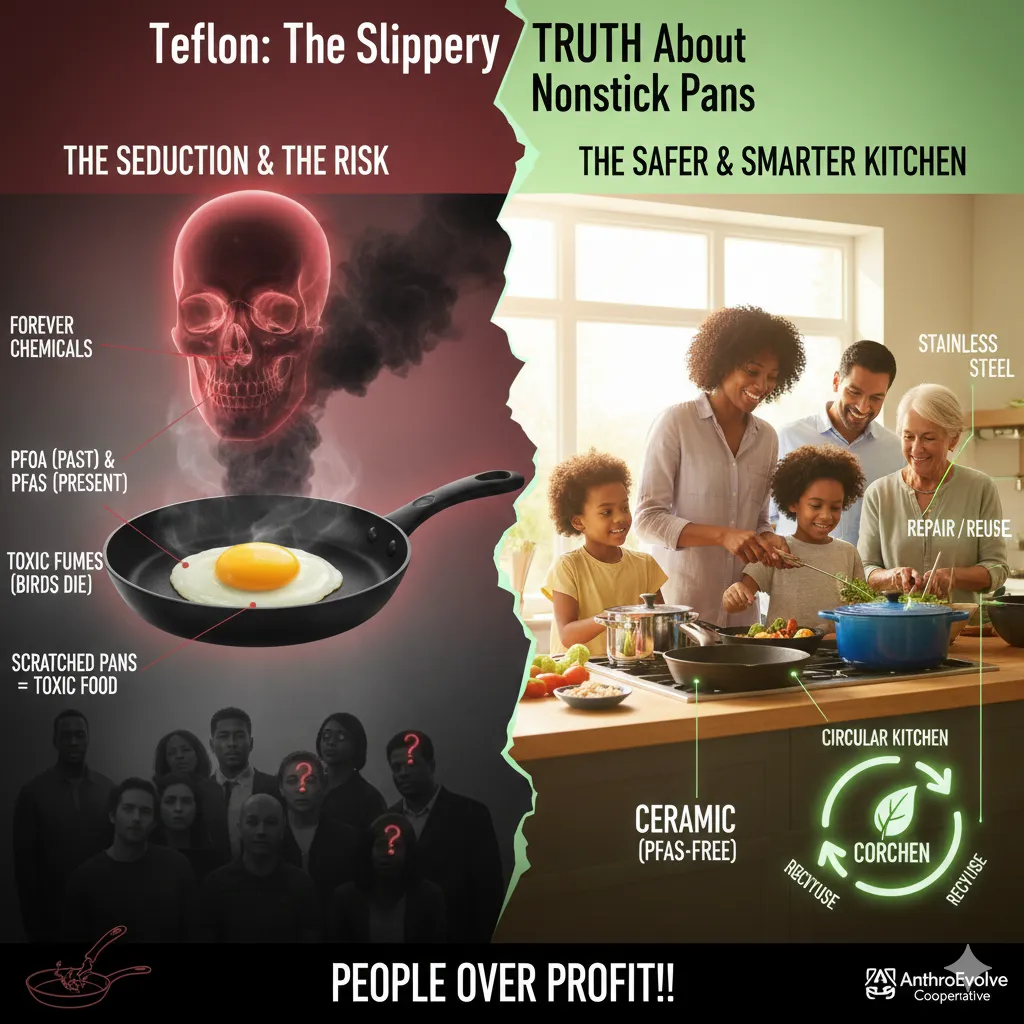
If you’ve ever watched an egg slide around a pan like it’s skating on ice, you’ve seen the seduction of Teflon in action. No sticking, no scrubbing, minimal effort.
But behind that slippery surface is a bigger story about “forever chemicals”, health concerns, and what we’re actually cooking into our lives when we prioritize convenience over caution.
Let’s unpack what’s really going on with Teflon pans, how worried to be, and which alternatives actually work without adding an extra side of toxic baggage.
1. First things first: what is Teflon?
“Teflon” is the brand name for PTFE (polytetrafluoroethylene), a synthetic fluoropolymer discovered in the 1930s. It’s incredibly slippery and chemically stable, which is why it became the darling of nonstick cookware.
Historically, PTFE was manufactured using PFOA (perfluorooctanoic acid), a type of PFAS, often called a “forever chemical” because it doesn’t readily break down in the environment or the human body.
Key context:
In the United States, major manufacturers phased out PFOA production by about 2015, under pressure from the EPA.
New formulations of PTFE-based nonstick coatings are typically advertised as “PFOA-free”, but still belong to the broader PFAS family.
So modern Teflon isn’t the exact same chemical cocktail as older pans, but it still lives in the PFAS universe, and that universe has some serious baggage.
2. PFAS 101: why people are nervous
PFAS (per- and polyfluoroalkyl substances) are used in nonstick pans, waterproof fabrics, grease-resistant packaging, firefighting foams, and more. They’re nicknamed “forever chemicals” because they’re extremely persistent and can accumulate in people and ecosystems.
Health agencies like the CDC/ATSDR, EPA, and multiple research groups have identified associations between exposure to certain PFAS (including PFOA and PFOS) and:
Increased cholesterol levels
Decreased vaccine response in children
Changes in liver enzymes
Increased risk of kidney and testicular cancer
Possible effects on thyroid function, immune function, and fetal development
The American Cancer Society notes that studies of people exposed to higher levels of PFOA (like workers or communities near factories) have found links to kidney and testicular cancer, and possible links to thyroid cancer, although research is still evolving.
Important nuance:
Most of the strongest evidence comes from occupational and environmental exposures, not from cooking a grilled cheese in a single pan. But if you’re trying to reduce PFAS in your life overall, nonstick cookware is a very reasonable place to start.
3. Are Teflon pans themselves dangerous?
This is where things get subtle.
Normal use vs overheated pans
Major medical and cancer organizations generally say that using an intact Teflon-coated pan at normal cooking temperatures appears to pose low direct risk to humans.
The problems show up when pans are:
Overheated
Empty on a burner (especially high heat)
Badly scratched, flaking, or damaged
At high temperatures (around 260–300°C / 500–570°F and above), PTFE can start to break down and release fumes.
These fumes have been linked to:
Polymer fume fever in humans: a temporary, flu-like illness with chills, fever, and chest discomfort after breathing in fumes from overheated PTFE.
Acute death in birds: avian veterinarians have warned for decades that fumes from overheated nonstick pans can kill pet birds very quickly, and manufacturers explicitly warn bird owners to keep birds out of the kitchen.
Birds are “canaries in the kitchen” in a very real sense; their extreme sensitivity is a blazing red flag that these fumes are not benign.
Scratched & flaking pans
When nonstick coatings are badly scratched or flaking, there are two issues:
You’re more likely to overheat the pan, because you need higher heat to keep food from sticking.
Tiny pieces of coating can end up in food.
Available evidence suggests that swallowing small flakes of PTFE is likely less concerning than inhaling fumes, because PTFE is relatively inert in the gut.
Still, a scratched, flaking pan is a sign that the coating is degrading. Practically speaking, it’s a good moment to say “thank you for your service” and retire it.
4. The wider PFAS picture: it’s not just the pan on your stove
Even if your individual pan isn’t the main villain, PFAS used across the nonstick supply chain and food system absolutely are a big deal.
A few key points:
PFOA was widely used in making Teflon and found in the blood of the vast majority of Americans before the phase-out.
PFAS have contaminated drinking water, soil, and food chains around industrial sites and military bases.
The FDA has moved to eliminate PFAS used as grease-proof coatings in food packaging, completing a phase-out in 2024–2025 to reduce food-contact PFAS exposures.
So when you look at your Teflon pan, it’s part of a larger PFAS story: production, pollution, water contamination, and long-term health research. For many people, choosing PFAS-free cookware is about stepping out of that system where possible.
5. How worried should you personally be?
Here’s a balanced, reality-based answer:
If you’re using older nonstick pans (pre-2013-ish)
They were more likely made with PFOA during manufacturing.
That doesn’t mean your dinner is poisonous, but if they’re old, worn, or flaking, it’s very reasonable to replace them with safer alternatives.
If you’re using newer “PFOA-free” nonstick
They still typically rely on PTFE or other PFAS-like chemistry.
Normal, low-to-medium heat use probably isn’t a major direct exposure source compared to water or packaging, but:
Avoid heating them empty.
Avoid broiling or searing on max heat.
Retire them when the surface is scratched, warped, or flaky.
If you’re pregnant, have young children, or are trying to reduce PFAS overall
Given what we know about PFAS and development, immune function, and cholesterol, many public health experts advocate a “precautionary” approach: minimize avoidable exposures where feasible.
Nonstick pans are one of the easiest swaps to make over time, especially when good alternatives exist.
6. Safer alternatives to Teflon & PFAS-based nonstick
The good news: your eggs can still slide, your pancakes can still flip, and your veggies can still sauté beautifully without Teflon.
Health-oriented guides, testing labs, and consumer groups consistently point to a few safer cookware families:
1. Stainless steel
Pros: Durable, PFAS-free, great for searing, sautéing, and deglazing; oven-safe.
Cons: There is a learning curve to prevent sticking (preheat + enough fat + don’t fuss with the food too early).
Best for: everyday cooking, sauces, stews, anything with a bit of liquid or fat.
2. Cast iron (and enameled cast iron)
Pros: Naturally nonstick when well seasoned; PFAS-free; holds heat beautifully; will literally outlive you.
Enameled cast iron (like classic Dutch ovens) has a glass-like coating, not PFAS.
Cons: Heavy; raw cast iron requires seasoning and some care.
Best for: searing, frying, roasting, one-pot meals, oven-to-table dishes.
3. Carbon steel
Pros: Like a lighter, thinner cousin of cast iron; can become very nonstick when seasoned; PFAS-free.
Cons: Needs seasoning; can react with very acidic foods.
Best for: high-heat cooking, stir-fries, delicate proteins once well seasoned.
4. True ceramic & quality ceramic-coated pans
Pros: PFAS-free; smoother nonstick experience closer to Teflon without the same chemistry.
Cons: Coatings can wear over time; quality varies a lot by brand.
Best for: eggs, pancakes, lower-to-medium heat tasks, quick sautés.
5. Glass & enamelware
Pros: Great for baking and oven dishes; inert; PFAS-free.
Cons: Not as nonstick as Teflon for stovetop frying.
Best for: casseroles, roasting, baking.
When you see “non-toxic cookware” guides from independent testers and food publications, they overwhelmingly center stainless steel, cast iron, carbon steel, glass, and PFAS-free ceramics as the safest bets.
7. How to transition away from Teflon without pan-panic
You don’t have to throw everything out tomorrow (unless a pan is flaking and tragic).
Here’s a stepwise plan:
Step 1: Audit your current pans
Pull them out and ask:
Is the coating scratched, chipped, or flaking?
Do I often cook on high heat with this pan (stir-fry, searing, broiling)?
Is this pan older than ~8–10 years with unknown chemistry?
If yes, those are top candidates to replace.
Step 2: Replace your highest-heat nonstick pan first
High heat + Teflon is the worst combo.
Your first swap could be:
A cast iron or carbon steel skillet for searing and stir-fry
Or a good stainless steel pan once you’re ready to practice the “heat + fat + patience” method
Step 3: Keep one nonstick pan (for now) for delicate jobs
If you’re not ready for a full Teflon divorce:
Keep one newer, PFOA-free pan in decent shape for eggs and crepes.
Use it only on low to medium heat.
Never heat it empty or under a broiler.
Retire it at the first sign of serious wear.
Step 4: When you buy new, vote with your dollar
Look for labels like:
“PFAS-free” or “PTFE-free” (especially on “nonstick” products)
Stainless steel, cast iron, carbon steel, glass, ceramic
And remember: marketing terms like “green,” “eco,” or “non-toxic” are not regulated. The material itself is what matters.
8. Bottom line: what’s on your stove shapes more than your dinner
Teflon pans are a gateway into a bigger conversation about what we normalize in our homes:
PFAS are linked to real health concerns in communities with high exposure
Overheated nonstick pans can release fumes that sicken humans and kill birds.
The industry has phased out some of the worst actors (like PFOA), but often by swapping in other PFAS cousins we’re still learning about.
You don’t need to be terrified of every pan in your kitchen. But you do get to decide what future you’re funding and breathing, one skillet at a time.
If your goal is to:
Reduce your PFAS footprint
Support cleaner production
Protect vulnerable bodies (kids, birds, ecosystems, your own)
…then shifting toward PFAS-free cookware is a powerful little daily rebellion.
Sources & Further Reading
American Cancer Society – PFOA, PFOS, and Related PFAS Chemicals
https://www.cancer.org/cancer/risk-prevention/chemicals/teflon-and-perfluorooctanoic-acid-pfoa.html www.cancer.org
ATSDR / CDC – Health Effects of PFAS
https://www.atsdr.cdc.gov/pfas/index.html
EPA – PFOA Stewardship Program & PFAS Risk Overview
https://www.epa.gov/pfas/pfoa-and-pfos 19january2021snapshot.epa.gov
NRDC – “Why Nonstick Pans Are a Hot Mess” (2025)
https://www.nrdc.org/stories/why-nonstick-pans-are-hot-mess
WebMD – “Is It Safe to Use Products Containing Teflon Coating?”
https://www.webmd.com/healthy-aging/qa/is-it-safe-to-use-products-containing-teflon-coating
VCA Animal Hospitals – PTFE / Teflon Fumes and Birds
https://vcahospitals.com/know-your-pet/teflon-toxicity-in-birds
EWG – PTFE / Teflon Fumes and Birds
https://www.ewg.org/news-insights/news/ptfe-fumes-and-birds
BirdTricks – PTFE / Teflon Fumes and Birds
https://birdtricks.com/teflon-toxicity-in-birds
Carnero et al., 2021 – Presence of PFAS in the Environment and Health Effects (Environmental Research)
https://www.ncbi.nlm.nih.gov/pmc/articles/PMC7961433/
ATSDR – Toxicological Profile for Perfluoroalkyls
https://www.atsdr.cdc.gov/toxprofiles/tp200.pdf
FDA – Authorized Uses of PFAS in Food Contact Applications (2025)
https://www.fda.gov/food/food-additives-petitions/authorized-uses-pfas-food-contact-applications
Serious Eats – Consumer & Cookware Guides on Non-Toxic Alternatives
https://www.seriouseats.com/best-non-toxic-cookware-materials
Organic Authority – Consumer & Cookware Guides on Non-Toxic Alternatives
https://www.organicauthority.com/organic-food-recipes/safer-cookware-materials
Consumer Reports – Consumer & Cookware Guides on Non-Toxic Alternatives
https://www.consumerreports.org/cro/cookware/buying-guide/index.htm
Your Hair is Not Trash
Your Haircut Is Not Trash: How Salon Hair Could Be Compost, Climate Tool & Oil-Spill Sponge
Every time someone gets a trim, a small ecosystem’s worth of hair hits the floor.
In the U.S. and Canada alone, salons throw out about 31.5 tons of hair every single day. Zoom out and you get even wilder:
North American salons generate about 63,000 pounds of hair clippings every day.
Europe is estimated to toss 72,000 tons of human hair into landfills or drains each year.
One European hair-recycling startup estimates roughly 2.2 billion kilograms of human hair becomes waste globally every year.
Nearly all of that ends up in landfills or incinerators, where it releases methane and other greenhouse gases as it breaks down.
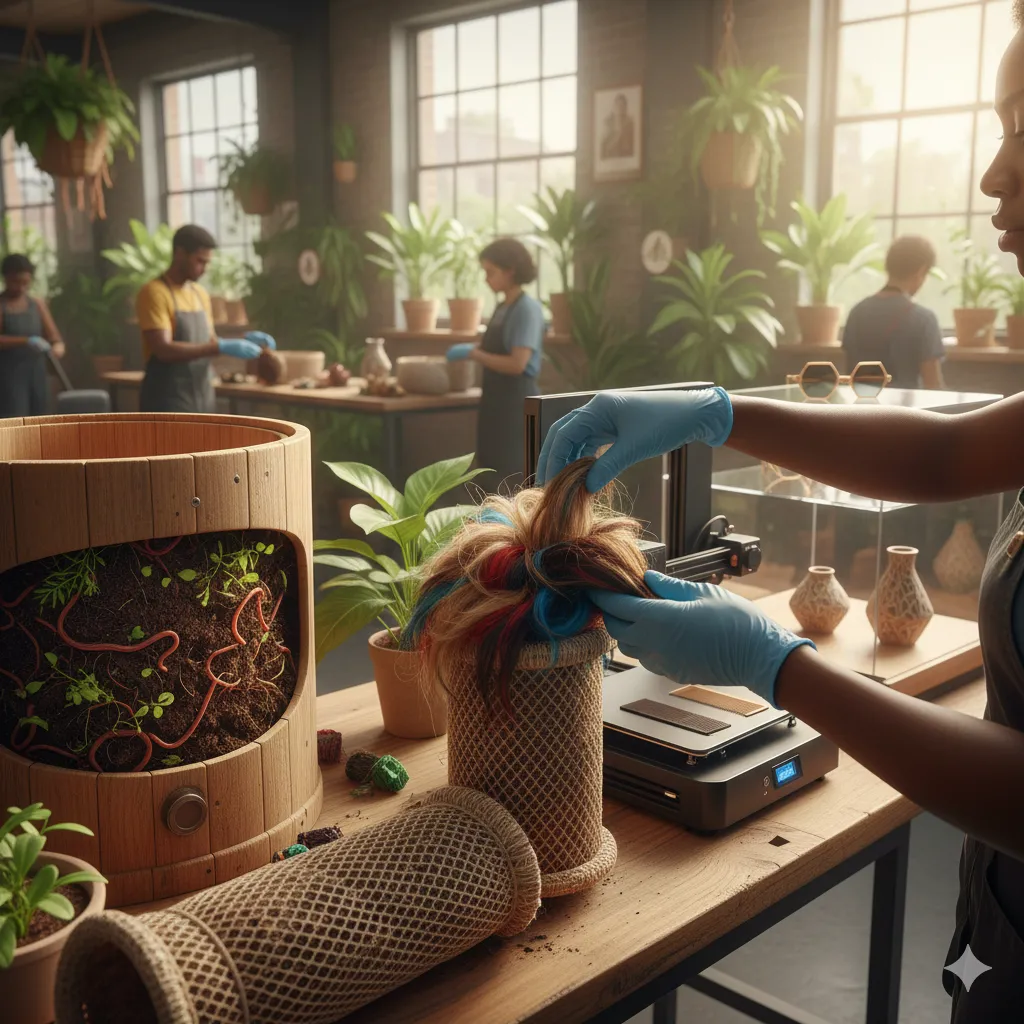
And that’s absurd, because hair is incredibly useful. The floor sweepings from your haircut can:
Feed compost as a slow-release nitrogen source
Help clean up oil spills
Replace plastics and chemicals in new biomaterials
The question isn’t “Can we use salon hair?” It’s “Why are we still treating it like trash?”
Is human hair compostable?
Short answer:
Yes, human hair is compostable.
But chemically treated hair should be handled with more caution.
The science bit
Hair is mostly keratin, a protein rich in nitrogen. Composting experts treat it as a “green” ingredient, like grass clippings, because of its high nitrogen content. Extension programs and composting guides note that human (and animal) hair can go into compost or be used as mulch, though it breaks down slowly.
Modern studies have even shown that salon hair mixed with compost makes a good plant nutrient source.
So from a purely biological standpoint: yes, hair will decompose and feed soil life.
Where it gets tricky: bleached & dyed hair
Most sustainability and composting educators land here:
Untreated hair (no chemical dyes, perms, straighteners, heavy product buildup)
→ Generally considered safe to compost in home systems or send to community compost.
Bleached, heavily dyed, permed, or chemically straightened hair
→ Often recommended to keep out of home or food-garden compost, because those treatments can leave synthetic chemicals and metals in the hair shaft that may leach into the pile.
Some municipal compost programs do accept dyed hair in small quantities, and a few explicitly say it’s fine. But for a “do no harm” approach, especially in gardens growing food, many zero-waste guides advise avoiding clearly chemically treated hair in your compost.
So a simple working rule:
Barber-shop style clippings (mostly natural hair) = great compost feedstock.
High-chemical salon lightening & vivid color = better sent to specialized recycling than to your tomato patch.
Why barbers are composting superheroes
Most barber shops:
Do a lot of dry cuts
Use little or no bleach/lightener
Rarely do full-head vivid coloring
Produce short, untreated hair clippings that break down faster
That makes them ideal partners for:
Local community compost sites
School gardens and urban farms
Hair-to-compost or hair-to-oil-boom programs
One eco-salon guide notes that human hair is compostable and can be sent to composting facilities instead of landfill, especially when it’s not full of chemical treatments.
If you’re a barber, you’re sitting on a goldmine of useful “waste.”
Hair vs oil spills: the wildly cool part
Now for the superhero move:
Hair doesn’t just compost. It also soaks up oil like a champ.
Why hair works on oil
Hair is:
Hydrophobic (repels water)
Lipophilic (loves oil)
Lab studies show human hair works as an effective, low-cost biosorbent for oil in water. It can absorb several times its weight in oil while letting water pass through.
Nonprofits and recycling programs turn donated hair into:
Hair mats (felt pads)
Hair booms (stocking-like tubes stuffed with hair)
These get deployed to:
Surround and contain oil slicks
Line storm drains and harbors
Catch leaks in industrial settings
For example:
Matter of Trust’s Clean Wave program in San Francisco collects hair, fur, wool and fleece to make mats and booms used in oil spills, storm drains and seagrass restoration projects.
In 2023, communities in the Philippines collected sacks of human hair to help respond to a serious coastal oil spill, tapping hair’s ability to trap oil.
Programs like Green Circle Salons and Sustainable Salons use salon hair to create oil-absorbing booms for spills at sea and in waterways, and even for industrial leaks.
Some of these hair booms can later be commercially composted after bacteria break down the captured oil, avoiding hazardous disposal routes.
So the stuff currently swept into black trash bags could literally be on the front lines of marine protection.
How much hair could we actually keep out of landfills?
Let’s put some rough numbers on it:
U.S. and Canadian salons toss out 31.5 tons of hair every day.
Green Circle Salons estimates about 63,000 pounds of hair are thrown away daily in North America alone.
Green Salon Collective says 6,700 tonnes of hair waste from salons are discarded each year in their region, and 98% of it currently goes to landfill.
Across Europe, one estimate suggests 72,000 tons of hair waste a year ends up in landfills or drains.
Globally, companies like CLIC RECYCLE estimate around 2.2 billion kilograms of human hair become waste annually.
If even half of that were diverted into compost, oil-spill tools, soil restoration, or biomaterials, we’d be talking about:
Tens of thousands of tons of organics not rotting in landfills
Significant methane emissions avoided
A steady stream of material for regenerative projects
All from something we literally pay to have cut off.
Who actually recycles hair today?
Here are some of the key players and programs (great resources to link in your blog):
1. Matter of Trust – Clean Wave (global)
What they do: Turn donated hair, fur, wool, and fleece into mats and booms for oil spill response, storm drains, and soil/seagrass restoration.
Who can donate: Salons, barbers, groomers, farms, and individuals.
Where: Based in the U.S. but accepts international shipments (check their current guidelines).
2. Green Circle Salons (U.S. & Canada)
What they do: Certified B Corp that helps salons recycle up to 95% of beauty waste, including hair, metals, color, and PPE.
Hair uses: Hair booms for oil spills, compost, and even specialty bioplastics and products like combs and recycling bins.
3. Green Salon Collective (UK & Ireland)
What they do: Collect and recycle salon hair, metals, chemicals, PPE and more.
Hair uses: Over ten different pathways, including compost, hair booms, felt, rope, garden products and art.
Also the source for that 6,700-tonne hair waste / 98% to landfill estimate.
4. Sustainable Salons (Australia & New Zealand)
What they do: Resource recovery program for salons across ANZ aiming for zero waste.
Hair uses: Hair booms for marine and industrial oil spills, plus other circular projects; they even support pet-fur recovery programs for oil-spill booms.
What they do: Collect salon hair waste in Spain, Portugal, the Netherlands and beyond, turning it into nature-based solutions that help clean soil and water, and replace plastics and agrochemicals.
5. CLIC RECYCLE & new European initiatives
What they do: Collect salon hair waste in Spain, Portugal, the Netherlands and beyond, turning it into nature-based solutions that help clean soil and water, and replace plastics and agrochemicals.
6. TerraCycle & SalonCycle (paid options)
TerraCycle itself runs brand-funded free programs mainly for beauty packaging, not hair.
But with SalonCentric they created SalonCycle, a zero-waste box system where salons can pay to send in mixed waste. Some boxes explicitly accept human hair (for composting) and synthetic hair (with color residues turned into energy under regulations).
So yes, TerraCycle-adjacent hair recycling exists, but it’s typically a paid, salon-scale solution.
What salon owners can do this year
If you run a salon or barber shop and want your hair to do more than sit in a landfill, here’s a doable path:
Segregate hair from other waste
Put a dedicated “hair only” bin at each cutting station.
Keep it free of foils, tissues, plastic, and heavy product blobs as much as possible.
Separate untreated from heavily treated hair (if you can)
Barber-style cuts and trims on mostly natural hair = best candidates for compost or hair-for-oil-booms programs.
Bleach/vivid colour clippings can go to specialized recyclers (e.g., Green Circle, Green Salon Collective, SalonCycle) rather than home compost.
Partner with a hair-recycling organization
In North America: explore Green Circle Salons or TerraCycle’s SalonCycle boxes.
In UK/Ireland: look at Green Salon Collective.
In ANZ: Sustainable Salons.
Globally: Matter of Trust accepts hair for oil-spill mats and booms.
Offer “hair to-go” for compost-friendly clients
If a client has untreated hair and wants to compost at home, send their clippings in a paper bag with a little info card.
Tell the story
Put a sign at the mirror:
“Your hair today is headed to [compost / oil-spill booms / soil restoration], not landfill.”
Share before/after stats: “This salon diverts X pounds of hair from landfill each month.”
What everyday clients can do
You don’t have to own the salon to shift the system. You can:
Ask: “Do you recycle hair clippings here?”
If they don’t, share links to programs like Matter of Trust, Green Circle Salons, Green Salon Collective, Sustainable Salons, or CLIC RECYCLE.
If your hair isn’t heavily chemically treated, ask:
“Would you mind putting my hair in a separate bag? I’d love to compost it or donate it.”
Choose salons that talk openly about waste diversion, composting, and recycling as part of their values.
Every time you ask, you’re quietly voting for a world where your haircut helps oceans and soils instead of stuffing landfills.
The big picture
Human hair is:
A high-nitrogen, compostable resource
A powerful tool for soaking up oil
A feedstock for new biomaterials that replace plastic and chemicals
Yet right now, almost all salon hair is still treated like trash.
If barber shops, salons, and clients start seeing hair clippings as tiny climate tools, we can:
Cut methane emissions from landfills
Support community compost and soil health
Strengthen grassroots responses to oil spills
Spark whole new circular industries around a “waste” we already create every day
That’s the kind of quiet, everyday systems-shift that adds up fast.
Sources & Further Reading
Green Circle Salons – Hair waste & beauty waste stats
Overview of salon waste streams and the estimate that salons in North America generate about 63,000 pounds of hair waste per day.
Waste360, Green Circle Salons, Forbes
Green Salon Collective – Hair waste in the UK & recycling pathways
Reports that 6,700 tonnes of human hair waste are produced annually in UK hairdressing, with about 98% going to landfill, plus innovative recycling uses.
Salon Gold, Green Salon Collective, Blue Patch
Matter of Trust – Hair mats / Hair Matters (formerly Clean Wave)
Program info on donating human and animal hair for mats and booms used in oil-spill response and storm drains.
Matter of Trust
Sustainable Salons – Hair booms & oil-spill applications
Explains how salon and pet hair are turned into oil-absorbing booms and composting of used booms.
Sustainable Salons
Zheljazkov, V.D. (2008). “Human Hair as a Nutrient Source for Horticultural Crops.” HortTechnology.
Research on human hair combined with compost as a slow-release nitrogen source.
ASHS HortTechnology
Matter of Trust
Insteading – “Can I Compost Hair? A Comprehensive Guide” (2023)
Guidance on composting human and animal hair, noting caution with chemically treated hair.
Insteading
Ifelebuegu, A.O. (2015). “Liquid-phase sorption characteristics of human hair as a low-cost oil spill sorbent.”
Study supporting hair’s effectiveness as a biosorbent for oil spills.
ScienceDirect
Matter of Trust
jeta.segi.edu.my
CLIC RECYCLE – Hair waste circular solutions
Describes transforming 2.2 million kg of human hair waste into biomaterials for soil and water restoration.
Cadena SER, ClicRecycle, European Commission Cinea
ScienceDaily – “Human Hair Combined With Compost Is Good Fertilizer for Plants”
Popular summary reinforcing hair as a fertilizer source when combined with compost.
ScienceDaily
Waste & salon-sustainability features (IBW Aveda blog, BeautyMatter, etc.)
Articles profiling beauty industry waste and programs like Green Circle Salons.
Waste360, Craft and Theory Hair, BeautyMatter
Blue Patch / industry blogs on cutting down salon waste
Discusses practical steps for salons to reduce waste and recycling statistics.
Salon Gold, Blue Patch, Estetica Magazine
General composting & sustainability blogs / guides
Guides emphasizing hair as a nitrogen-rich material and sustainability in salon waste.
Jo Hearts Hair, ResearchGate, Facebook Sustainability Groups
Freshwater: The Lifeblood Beneath Our Feet and Flowing Through Our World

Freshwater is more than a resource — it’s the quiet architect shaping civilizations, feeding ecosystems, irrigating global food systems, and sculpting the landscapes we treasure. Every river bend, every wetland brimming with life, every cup we drink comes from a tiny sliver of Earth’s water budget. Out of all the water on the planet, only 2.5% is freshwater, and less than 1% is truly accessible.
In other words: the thing we depend on most is also one of the things we understand least.
To protect our communities, our economies, and our future, we need to understand how freshwater systems work — what nourishes them, what threatens them, and what we can do now to avoid a global “Day Zero.”
Let’s dive in.
1. Groundwater vs. Surface Water: A Dynamic Duo We Depend On
Most of us imagine freshwater as the sparkling, sunlit water we can see — the rivers braiding through valleys, the lakes reflecting neon sunsets, the reservoirs supplying cities. This is surface water, the visible layer of Earth’s water cycle.
Surface Water
Surface water includes rivers, lakes, streams, ponds, and man-made reservoirs. Because it’s exposed, it’s incredibly vulnerable to what happens on land:
Fertilizer runoff feeding algal blooms
Industrial waste
Untreated sewage
Warming temperatures accelerating evaporation
Chemical contamination
Surface water can be replenished quickly — rainfall, snowmelt, and seasonal storms top up the system. But that “renewability” only works if climate and precipitation patterns remain predictable. Increasingly, they aren’t.
Groundwater
Then there’s groundwater — the hidden giant.
Stored in underground layers of porous rock, sand, or gravel called aquifers, groundwater makes up the largest accessible freshwater reserve we have. It fills slowly, over decades to millennia, through nothing more glamorous than gravity and patience.
We access it through:
Wells (private and municipal)
Springs
Irrigation systems
Public water infrastructure
In the U.S., groundwater provides:
~40% of all freshwater
Over 90% of rural drinking water
~30% of irrigation water nationwide
Yet this critical reserve is not limitless — and once it’s emptied or contaminated, recovery can take generations.
2. The Consequences of Over-Pumping: When We Pull Too Hard on the Planet’s Lifeline
When groundwater is extracted faster than nature can replace it, the consequences ripple across landscapes, economies, and ecosystems.
a. Land Subsidence: When the Ground Sinks Beneath Us
Aquifers don’t just hold water — they provide structural support underground. When we empty them, the land above can collapse.
In California’s Central Valley, some areas have sunk up to 30 feet in the last century. Thirty. Feet.
Subsidence is not slow-motion science fiction. It destroys:
Roads
Homes
Canals
Irrigation systems
Pipelines
And once ground compacts, it can’t “fluff” back up. That storage capacity is lost forever.
b. Reduced River & Spring Flow
Most rivers aren’t fed by rain alone — they’re fed by groundwater seepage. Pump too much groundwater, and rivers shrink or vanish entirely.
This can:
Turn year-round rivers into seasonal trickles
Collapse fish populations
Dry wetlands
Starve entire ecosystems
Groundwater and surface water are not separate systems. They are one circulatory network.
c. Saltwater Intrusion
Along coastlines, freshwater aquifers act as barriers holding back ocean water. When aquifers are drained, that delicate balance breaks — and saltwater pushes inland.
Once saltwater intrudes, aquifers can become undrinkable. Florida, Louisiana, and parts of California are already facing this battle.
d. Sinkholes
In regions with limestone bedrock — known as karst terrain — groundwater carves out caves and pockets underground. Remove too much water, and the roof collapses.
Cue: sudden chasms in yards, parking lots, roads, and fields.
Which leads us into the secret world beneath our feet…
3. Sinkholes, Caves, and the Strange World Beneath Us
Around 20% of Earth’s land is karst — landscapes made of dissolving limestone and peppered with underground rivers, chambers, and voids.
This makes karst both mesmerizing and dangerously fragile.
Living Caves
“Living” caves are still connected to flowing groundwater.
You can recognize them by:
Dripping limestone formations
Active stalactite and stalagmite growth
Moist, mineral-rich air
Microbial ecosystems
Constant reshaping by water
They’re dynamic — a geological organism in motion.
Dead Caves
A “dead” cave is a fossilized chamber, cut off from the groundwater that once passed through it.
Signs include:
Dry rock
Still air
Dusty, brittle mineral formations
No dripping or mineral growth
Why does this matter?
Because when active caves dry out, it signals that the groundwater feeding them has receded — often due to climate change or over-pumping.
Caves are canaries in the Earth’s hydrological coal mine.
4. Freshwater Resources in the United States: Abundant but Uneven
The U.S. has enormous freshwater wealth — but it’s not evenly distributed, and it’s under escalating pressure.
Major Freshwater Assets
The Great Lakes – 20% of Earth’s surface freshwater
Colorado River Basin – lifeline for 40 million people
Ogallala Aquifer – supports 30% of U.S. irrigation
Mississippi River System – agricultural powerhouse
Alaskan glaciers and snowfields
Pacific Northwest river systems
Stressors Turning Abundance Into Scarcity
Megadroughts across the West
Groundwater over-pumping
Urban sprawl and high water demand
Agricultural intensification
Industrial contamination
Shrinking snowpack and altered snowmelt timing
We aren’t “running out of water” nationally — but certain regions are hitting the limits of what their watersheds can sustainably provide.
5. Cape Town’s Water Crisis: A Near-Miss That Changed the World
In 2018, Cape Town became the first major city in modern history to publicly count down to “Day Zero” — the day the municipal taps would literally run dry.
What Went Wrong?
Cape Town faced a perfect storm:
Multi-year drought
A growing population
Over-reliance on surface reservoirs
Delayed infrastructure upgrades
Poor drought planning
Reservoirs fell to dangerously low levels. Governments announced Day Zero. Panic set in.
How They Saved the City
Cape Town's response is now a global case study in emergency water governance. They implemented:
Strict 50-liter-per-person-per-day limits
Aggressive leak repair programs
New groundwater wells
Temporary desalination plants
Water reallocation from agriculture
Citywide education campaigns
Real-time dashboards showing reservoir levels
And it worked.
Day Zero was postponed — then avoided altogether.
But the message was unmistakable: even developed cities can run out of water.
6. New Water Technologies That Could Save Our Future
The future of water security will be a blend of conservation, innovation, and smarter management. Here are some of the most promising technologies:
A. Atmospheric Water Generators (AWGs)
These machines pull water vapor directly from the air — producing clean drinking water without tapping groundwater or rivers. They’re making waves in arid regions and disaster-response zones.
B. Advanced Desalination
New materials like graphene membranes are reducing the cost and energy footprint of turning seawater into freshwater. Solar desalination and zero-liquid-discharge systems could make desalination far more sustainable.
C. Managed Aquifer Recharge (MAR)
This method captures excess stormwater or treated wastewater and injects it back into aquifers — refilling groundwater stores before droughts hit. California, Arizona, Israel, and Australia are leading the way.
D. Nutrient Capture Technologies
By removing nitrogen and phosphorus from wastewater, these systems prevent algal blooms and eutrophication while recovering valuable nutrients for agriculture.
E. Potable Water Reuse
Cities like Singapore, Perth, and Orange County have embraced advanced purification systems that turn wastewater into ultra-clean drinking water — safely, sustainably, and at scale.
F. Smart Water Networks
IoT sensors embedded in pipes and reservoirs are already detecting leaks, tracking contamination, and optimizing pressure. These systems can save billions of gallons annually just by preventing loss.
7. So… What Do We Do Next?
If we want a future where freshwater still flows like possibility itself, we need a new relationship with it — one rooted in respect and responsibility.
That means:
Protect the sources we still have
Use less, and use it smarter
Recycle water wherever possible
Restore aquifers with MAR systems
Fund technologies that stretch supply
Transform agricultural water habits
Educate consumers (the heart of your mission)
Above all, we need to treat water not as a commodity but as a shared inheritance — one we must safeguard for future generations.
Further Reading: The Science Behind Our Freshwater Story
If you’re curious to dive deeper into the hidden machinery of freshwater systems — how aquifers breathe, why rivers bloom and choke, how cities nearly run dry, and which technologies might rescue us — these peer-reviewed studies and authoritative reports form the backbone of today’s understanding. Each one adds a layer of nuance to the story.
Groundwater, Aquifers, and the Cost of Over-Pumping
To understand why groundwater behaves the way it does — rising slowly, draining faster than we can afford, and sometimes collapsing the land above — the U.S. Geological Survey offers some of the clearest, most accessible science. Their overview on national groundwater decline explains the mechanics of aquifer depletion, pumps, recharge, and long-term impacts:
https://www.usgs.gov/special-topics/water-science-school/science/groundwater-decline-and-depletion
USGS’s report Land Subsidence in the United States brings the issue into sharper relief, showing how over-pumping in places like California’s Central Valley has caused dramatic sinking of the ground surface. It’s a sobering look at how quickly geology can be reshaped when underground support disappears:
https://pubs.usgs.gov/circ/circ1182/
On the scientific front, Leonard Konikow’s paper Long-term groundwater depletion in the United States analyzes decades of national aquifer trends and quantifies just how much we’ve lost — and are still losing:
https://doi.org/10.1002/2014WR016687
For a global perspective, Yoshihide Wada and colleagues reveal how interconnected our water crisis truly is in Global depletion of groundwater resources, showing depletion in agricultural regions worldwide:
https://doi.org/10.1029/2010GL044571
Nutrients, Algal Blooms, and Eutrophication
Eutrophication is one of the most visible symptoms of water mismanagement — rivers turning neon green, lakes smothered by algae, dead zones expanding offshore. One of the most frequently cited syntheses on this topic is by Smith, Tilman, and Nekola, who outline precisely how nutrient overload alters freshwater ecosystems:
https://doi.org/10.1016/S0269-7491(99)00090-3
The U.S. Environmental Protection Agency also provides an authoritative explanation of nutrient pollution, offering real-world examples, causes, and impacts on both water quality and human health:
https://www.epa.gov/nutrientpollution/problem
Caves, Karst Landscapes, and the Collapse Beneath Our Feet
If you want to understand the world beneath our feet — the hollow caverns, flowing conduits, and slow-forming stalactites that tell the story of groundwater movement — Derek Ford and Paul Williams’ textbook Karst Hydrogeology and Geomorphology is a definitive resource. Though academic, it reads like a geological detective story.
The Geological Society of America also hosts Arthur Palmer’s landmark paper Origin and morphology of limestone caves, which explains how “living” caves continue to grow while “dead” caves stand as dry fossils of past water flow:
https://doi.org/10.1130/0016-7606(1991)103<0001:OAMOLC>2.3.CO;2
And for a clear, public-friendly explanation of sinkholes — why they form, where they occur, and how groundwater contributes — the USGS fact sheet is an excellent companion:
https://pubs.usgs.gov/fs/2007/3060/
Freshwater Resources in the United States
America’s water narrative is complex: immense, abundant, but uneven and under growing pressure. The U.S. Geological Survey’s national water-use assessment is one of the most comprehensive snapshots of how water flows through cities, farms, industries, and ecosystems:
https://pubs.usgs.gov/circ/1441/circ1441.pdf
For anyone trying to understand where our water actually comes from, the USGS’s map and descriptions of the country’s major aquifers are indispensable:
https://water.usgs.gov/ogw/aquifer/
On a global level, Tom Gleeson and colleagues used satellite data (GRACE) to measure groundwater losses planet-wide, revealing just how many of the world’s aquifers are being drained faster than they can refill:
https://doi.org/10.1038/nature11295
The Cape Town “Day Zero” Crisis
No modern city has come as close to running out of water as Cape Town. Several academic analyses explore how the crisis unfolded and how the city pulled itself back from the brink. Johan Enqvist and Gina Ziervogel offer a nuanced look at the governance issues and social inequities exposed during the drought:
https://doi.org/10.1002/wat2.1354
Laura Rodina’s work expands on the idea of water resilience, detailing the strategies that helped Cape Town adapt under immense pressure:
https://doi.org/10.1002/wat2.1354
And in a shorter but provocative piece published in Nature, Mike Muller argues that while climate change played a role, governance and water-planning failures were equally critical:
https://doi.org/10.1038/d41586-018-05649-1
Emerging Water Technologies for a Thirstier World
From desalination to atmospheric water harvesting, researchers have been racing to develop technologies that can stretch or reinvent freshwater supplies. One of the most thorough overviews is the Nature paper Science and technology for water purification in the coming decades, a deep dive into future membranes, materials science, and treatment systems:
https://doi.org/10.1038/nature06599
For desalination specifically, Menachem Elimelech and William Phillip provide an expert analysis of the energetic, environmental, and technological barriers we still face — and where breakthroughs are happening:
https://doi.org/10.1126/science.1200488
Managed Aquifer Recharge (MAR), one of the most promising tools for replenishing groundwater, is explored in depth by Dillon et al. in their review of MAR as a resilience strategy:
https://doi.org/10.1002/wat2.1349
If you’re curious about how recycled water fits into the American water future, the National Academies’ report The Role of Reuse in the U.S. Water Supply is one of the most comprehensive evaluations available:
https://nap.nationalacademies.org/catalog/21866/water-reuse-expanding-the-nations-water-supply-through-reuse-of
Finally, Peter Gleick’s book The World's Water series remains a touchstone for anyone wanting to understand global freshwater politics, scarcity, and innovation.
From Metacrisis to Momentum: How Distributive Capitalism & Co-ops Can Save the Day
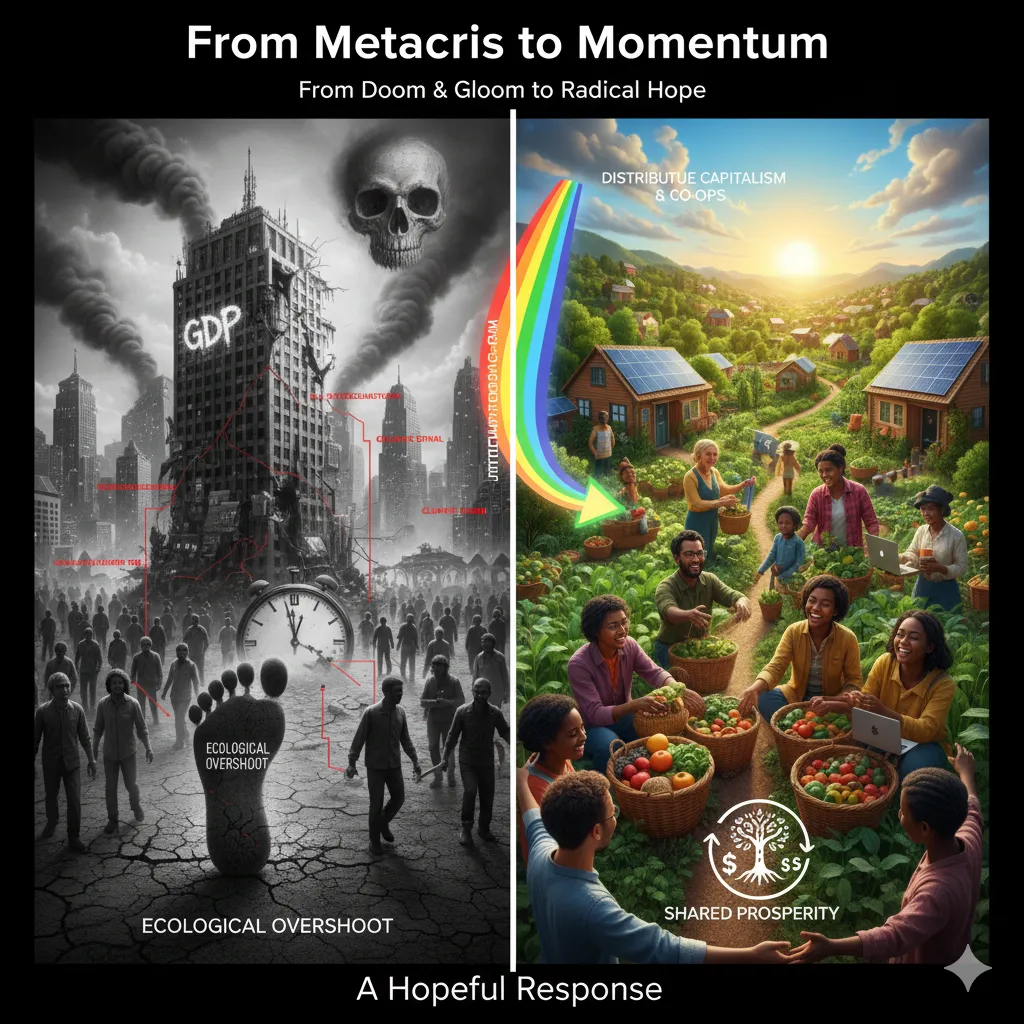
Reframing the Crisis – and Our Power to Change It (A Hopeful Response)
The world’s dominant economic mindset is on trial.
A recent critique of the “Metacrisis Mindset” exposed how Western culture’s toxic fixation on exponential growth fuels overconsumption, ecological overshoot, and climate denial. The picture it paints is bleak: WEIRD societies (Western, Educated, Industrialized, Rich, Democratic) are stuck chasing endless GDP growth at any cost. We’ve now spent over half a century in chronic ecological overshoot, treating our one Earth like it’s five. No wonder this entrenched mindset leaves many feeling paralyzed and hopeless.
But hope is not lost – not by a long shot. It’s time for a new vision that breaks through the paralysis. In this response, I want to turn that critique into a springboard for action. Let’s talk about “distributive capitalism” and the power of cooperatives as game-changers. By reimagining how we spend, save, and invest, we can flip the script from destructive growth-at-all-costs to regenerative shared prosperity. This isn’t pie-in-the-sky idealism; it’s a fierce, playfully bold optimism grounded in real-world examples and emerging movements. Buckle up – we’re about to journey from doom and gloom to a radical hope you can act on today.
Exponential Growth: The Toxic Logic We Must Unlearn
Western culture has long equated more with better. We’re taught that a “successful” economy is one that grows infinitely, year after year – an absurd notion on a finite planet. As economist Kate Raworth bluntly put it, the 20th-century idea that GDP should “go up forever” is insanity. Yet this insanity is embedded in everything from our holiday shopping frenzies to corporate boardrooms. We celebrate getting the most for the least – whether it’s snagging a Black Friday deal or squeezing supplier costs – with little thought to the hidden social and ecological price tag.
This exponential growth mindset is not just an economic theory; it’s a cultural trap. It’s in the relentless push for higher quarterly earnings, the expectation of bigger houses and cars, the way WEIRD economies define progress by consumption. We’ve built biases and business practices that perpetuate this logic, even as forests burn and ice caps melt. The reflective article highlighted two giant elephants in the room: overconsumption and overpopulation. Indeed, if everyone on Earth lived like the average American, we’d need about 5 Earths to sustain us. No billionaire’s Mars colony will change that math anytime soon.
It’s clear that endless growth economics is ecocidal. Using resources 1.7 times faster than Earth can regenerate is, by definition, a dead-end strategy. The “Metacrisis Mindset” is that collective state of denial – the delusion that we don’t need to profoundly change course. But here’s the good news: we can change course. To do it, we must unlearn the toxic logic that equates growth with goodness, and instead ask: Growth of what? For whom? At what cost? When growth comes at the expense of life-supporting ecosystems, it ceases to be progress at all. It’s time to adopt a new metric of success – one that measures health, equity, and sustainability, not just dollars circulating. Enter the heroes of our story: cooperatives and a new vision for capitalism itself.
Money Reimagined: Every Dollar as a Vote for Future We Want
Part of breaking free from the old mindset is shifting our relationship with money. Let’s face it: we’ve been conditioned to maximize personal gain – to get the most for the least. Hunt for the lowest prices, chase the highest returns, accumulate, repeat. But what has that gotten us? Cheap goods built to break, supply chains that exploit workers and pollute communities, investment portfolios tied up in fossil fuels and sweatshops. Our dollars often feed the very system that’s imperiling our future.
Now imagine flipping this around – seeing each dollar as a vote for the kind of world we want. This is the essence of distributive thinking: using every dollar to create the best outcomes for people and planet, not just the best bargain for ourselves. What does that look like in practice?
As consumers, it means spending with intention. Every time you buy something, you’re funding a business model. So choose to buy from companies that are fair, sustainable, and community-focused. (Better yet, from a cooperative – more on those soon!) It might mean paying a bit more for ethically made goods that last, instead of the throwaway fast-fashion or gadget that ends up in a landfill next year. It’s the mindset of quality and impact over quantity.
As savers and investors, it means putting our money where our values are. This could be moving your banking to a local credit union or community bank, where your deposits finance local businesses and neighbors’ mortgages instead of Wall Street speculation. It could mean shifting part of your retirement fund into an ESG (Environmental, Social, Governance) portfolio or community development financial institution. Or even investing in local renewable energy co-ops, community land trusts, and startups solving social challenges. Why leave all the investing to venture capitalists chasing unicorn profits? We the people can be venture catalysts for the common good.
As citizens, it means demanding better choices. Our policies and tax dollars should incentivize sustainable, equitable economic activity – not subsidize pollution and inequality. For instance, pushing for green infrastructure and jobs programs (like those outlined in a Green New Deal) and for financial regulations that rein in reckless speculation while supporting community investment. It also means supporting measures that make ethical choices easier and cheaper (think: tax credits for renewable energy and electric co-op projects, or penalties for heavy carbon emitters).
Reimagining money in this way transforms it from a self-centered tool into an engine of change. Instead of asking “How can I get more for my dollar?”, the new question becomes “How can my dollar do more good?”. And here’s the exciting part – millions of people are already moving money in this direction, through things like fair trade purchasing, impact investing, and banking with mission-driven institutions. Every time you choose a product that’s Fair Trade or a B Corp, every time you deposit in a credit union or donate to a grassroots cause, you are voting against the metacrisis mindset and for a better future. These individual choices, scaled up, start bending the entire system toward justice.
Cooperatives: Radical, Practical Vehicles for Change
If “distributive capitalism” is the vision, then cooperatives are the working model that brings that vision to life. Cooperatives (or co-ops) are businesses owned and governed by the people they serve – whether workers, consumers, or community members. Far from being fringe experiments, they are thriving real-world enterprises that prove we can succeed by sharing power and profits more broadly. In a world weary of corporate greed and shareholder primacy, co-ops are a breath of fresh air – radical yet practical vehicles for systemic change from the inside out.
Consider some facts: One in three Americans is a member of a cooperative enterprise of some kind! Yes, you read that right – co-ops are not a niche; they’re everywhere once you start looking. Credit unions, for example, are co-op banks – and over 140 million Americans (about a third of the country) choose them for their banking needs. Rural electric cooperatives bring power to 42 million people across 47 states, literally keeping the lights on for vast swathes of the country. And there are 29,000+ cooperatives in the U.S. spanning every sector – from agriculture and retail to housing, healthcare, and industry. These co-ops together generate 2 million jobs, $650+ billion in revenue, and hold over $3 trillion in assets. In other words, the cooperative sector is already a heavyweight part of our economy – often quietly so, because co-ops don’t have billion-dollar ad budgets to tout their brand.
What makes cooperatives so powerful as change agents? Three big things:
They democratize wealth and power. In a co-op, the profits and decision-making aren’t confined to a few distant shareholders; they belong to the members. Whether it’s workers voting on business decisions or consumers receiving dividends (like REI co-op members getting an annual rebate), co-ops inherently practice economic democracy. This directly tackles inequality by design – instead of funneling wealth upward, co-ops distribute it among those who helped create it. For example, farmer co-ops allow family farms to band together and get a fair price and ownership in processing their products, rather than being at the mercy of a giant corporate buyer. Worker-owned companies give employees a share of the profits their labor produces. This shared ownership builds a middle class and community wealth in ways traditional companies often do not.
They foster local resilience. Because co-ops are owned by local stakeholders, they are rooted in their communities. They are less likely to uproot jobs and run off in search of the next tax break or cheap labor market. Instead, they tend to reinvest locally and stick around for the long haul. Studies show co-ops have lower failure rates and can weather economic storms better than conventional businesses. During the 2008 financial crisis and again during the COVID-19 pandemic, cooperative banks and businesses were stabilizing forces. Co-ops also multiply local impact – for instance, food co-op grocery stores pump more back into local farmers and suppliers on average than big-box retailers. They’re community anchors that keep wealth circulating nearby rather than siphoning it off to distant investors. Want a resilient hometown? Co-ops are a proven tool to get there.
They embody a values-driven ethos (people and planet over profit). Most co-ops operate under guiding principles that prioritize member benefit, education, cooperation among cooperatives, and concern for community. This often translates into more ethical practices – paying fair wages, sourcing sustainably, providing affordable services. Credit unions, for example, frequently offer better rates and lower fees precisely because they exist to serve members, not maximize profits. Many co-ops were founded explicitly to fill social needs the market failed: rural electricity in the 1930s, affordable housing, organic food distribution, etc. It’s baked into their DNA to consider social and environmental returns, not just financial. So when you support a co-op, you’re usually supporting a business that’s already doing the right thing without needing to be forced by regulation or public pressure.
Crucially, cooperatives show that we don’t have to wait for some top-down revolution to start building a new economy. They let us practice a fairer, post-growth economics right now, within the shell of the old system. Every new co-op or credit union or mutual aid network is like a seed of the future sprouting in the present. And history gives us inspiring examples of co-ops literally changing the game. Remember how I mentioned rural electric co-ops? In the 1930s, only 10% of rural American households had electricity – private utilities saw no profit in serving them.
Farmers and neighbors organized cooperatives, got support from New Deal policy (loans, expertise), and pulled off a miracle: within a generation, they brought power to 90% of rural America. That’s millions of people lifted into the modern economy, thanks to cooperatives breaking through where pure capitalism failed. Talk about “system change from the inside”! Co-ops have been quietly revolutionary before – and they can be again, on everything from broadband access to clean energy.
What Is Distributive Capitalism? A Fair, Sustainable Vision
It’s time to put these pieces together into a compelling vision for our economy. Distributive capitalism is a term that captures the kind of economy we’re striving for: one that retains the dynamism and innovation of markets and enterprise, but fundamentally rewires them for fairness and sustainability. In a distributive capitalist system, wealth and value are widely shared (distributed) rather than concentrated, and the economy operates within biophysical limits instead of trashing the planet. Think of it as capitalism 2.0 – upgraded with an ethics and survival patch!
Key features of distributive capitalism include:
Broad-based ownership and benefits: This means structures like cooperatives, employee stock ownership plans (ESOPs), community-owned trusts, and public ownership of essential services. Instead of a few owning the means of production and nearly all the gains, many people own slices of the pie. For instance, imagine if large corporations were required to share ownership with workers and communities – profits would circulate locally and inequality would shrink. Co-ops are a prime example here, as we’ve discussed. The richest 1% have captured half of all new wealth globally in the past decade; distributive capitalism flips that script so value created by all gets enjoyed by all.
Embedded economic activity in community and ecology: Distributive capitalism localizes and regionalizes production where sensible, to reduce waste and strengthen communities. It prizes local resilience – shorter supply chains, local small businesses thriving, cities and towns with diversified economies. It also internalizes environmental costs instead of foisting them on the public. In practice, this could mean strong pollution limits, circular economy practices (reusing, recycling materials endlessly), and businesses being responsible for the full lifecycle of their products (so designing things to last and be repaired). It means acknowledging we have an ecological ceiling we must not overshoot, as Kate Raworth’s Doughnut Economics model illustrates.
The Doughnut economic model visualizes a safe space for humanity between an inner social foundation (where everyone’s basic needs are met) and an outer ecological ceiling (where we stay within planetary limits). This kind of balanced thinking is at the heart of distributive, sustainable capitalism, emphasizing thriving within our means rather than pursuing infinite growth.
Regenerative and inclusive by design: A distributive capitalist economy doesn’t grow for growth’s sake; it grows opportunities and well-being in alignment with nature. It aims to regenerate ecosystems (e.g. shifting to agriculture that builds soil and restores landscapes, energy systems that run on renewables) and to rectify historical inequalities (e.g. investing in marginalized communities, ensuring everyone has access to health, education, and dignified work). Growth per se is not the goal – thriving is. If GDP goes up but so do homelessness and CO₂ levels, that’s failure. Conversely, if GDP is stable or even smaller, but poverty drops and forests expand, that’s success. It’s a profound shift from quantity to quality. In fact, many proponents of this vision, like the Degrowth movement, argue that high-consuming nations must deliberately scale down material throughput to avoid ecological collapse – while improving quality of life by sharing more and wasting less. Degrowth doesn’t mean deprivation; it means living better with less stuff. It aligns with what Indigenous wisdom and new economics alike teach: enoughness can feel better than endless more.
The beauty of distributive capitalism is that it’s not an oxymoron – it’s already emerging. We see pieces of it in doughnut cities (from Amsterdam to Portland) adopting Raworth’s framework to guide policy, measuring success in new ways. We see it in the explosion of interest in employee ownership and solidarity economy initiatives across the United States. Heck, even within Silicon Valley’s backyard, there’s a growing ecosystem of cooperative startups, open-source collaborations, and localist movements pushing back on the winner-take-all ethos. Thought leaders like Raworth and groups like the Degrowth community are no longer on the fringe; they’re informing urban planners, CEOs, and lawmakers about what a viable future economy could look like. It’s an economy that is “distributive by design”, meaning it naturally tends to share value, and “regenerative by design”, meaning it works with circular processes like nature.
In U.S. policy terms, distributive capitalism might translate into things like: stronger antitrust enforcement (to break up monopolies and spur local competition), tax incentives for co-ops and social enterprises, a federal jobs guarantee or universal basic income to ensure the social foundation, and investment in green infrastructure at every scale. Notably, even within recent legislation, we see glimmers: for example, the Inflation Reduction Act of 2022 set aside nearly $10 billion specifically to help rural electric cooperatives build out renewable energy – essentially backing community-owned utilities to lead the clean energy transition. That’s a small taste of what’s possible when policy starts aligning with a distributive, sustainable approach.
To sum it up: Distributive capitalism = sharing our economic pie more fairly, and baking that pie in an oven that doesn’t wreck the kitchen (Earth). It’s realizing that thriving within our means is not only necessary but exhilarating – it opens the door to innovation in quality of life, not just quantity of consumption. And far from stifling entrepreneurship, it could unleash the next generation of innovators who measure success in human and ecological well-being. This is our economic revolution to make.
Stop Waiting for Billionaire Saviors – Hope Lies in Collective Action
It’s time for some real talk about hope. Too often, we’ve been fed a delusional hope in tech billionaires – a shiny myth that a few genius titans will ride in on electric cars and rockets to save civilization. We hear things like: “Elon Musk will colonize Mars so humanity has a backup plan,” “Bill Gates is investing in miracle nuclear reactors and geoengineering,” “Jeff Bezos’s philanthropy will solve climate change.” Let’s be clear: pinning our future on the good graces of a handful of ultra-rich individuals is not only undemocratic, it’s a dangerous distraction. These men (and yes, they’re mostly men) are products of the very system that’s in crisis. In fact, billionaires as a class lead the world in per-capita carbon emissions – their private jets, mega-yachts, and resource-intensive lifestyles leave gigantic footprints. Relying on them to fix climate change is like trusting arsonists to put out a fire they started. Sure, some tech moguls donate to green causes, but often it’s a tiny fraction of their wealth – gestures that burnish their image while their companies carry on with business-as-usual. For example, one study found a person in the richest 0.1% of Americans emits more CO₂ in a single day than a person in the poorest 10% does in an entire decade. Let that sink in. The climate crisis is not going to be solved by the same hyper-inequality that helped drive it.
So where do we place our hope? In each other. In collective action, in ordinary people organizing for extraordinary change, in the power of the many over the few. History consistently shows that the great leaps forward – for democracy, for civil rights, for public health, for environmental protection – happen because people banded together from the ground up to demand and create change. Not because a billionaire wrote a check, but because millions raised their voices and rolled up their sleeves.
We see this groundswell everywhere today, if we only look beyond the media hype of billionaire saviors. It’s in the youth climate strikes that have galvanized policy conversations worldwide. It’s in indigenous leaders and local communities halting pipelines and protecting forests. It’s in workers at companies like Starbucks and Amazon unionizing to claim a fairer share of the pie. It’s in the explosive growth of mutual aid networks during the pandemic, neighbors helping neighbors when official systems faltered. And it’s very much in the cooperative movement we’ve been spotlighting – tens of thousands of co-ops where people are taking back control of their economic destiny, together.
Grounded hope looks like this: citizens in towns and cities coming together to implement solutions, rather than waiting for a Silicon Valley Messiah or a Washington miracle. For instance, community-owned solar farms are popping up across the country, letting groups of residents jointly invest in clean energy and reap the benefits. In Cleveland, the Evergreen Cooperatives have employees from low-income neighborhoods owning and running solar installation, urban farming, and laundry businesses – creating jobs and wealth where outside investors had long neglected. In Maine, a coalition of everyday folks just formed a statewide Cooperative Development Fund to seed new co-ops in areas like childcare and fishing, with support from credit unions and even forward-thinking legislators. These stories rarely make flashy headlines, but they are real hope in action – the kind that builds and builds.
Even on the intellectual and policy front, the heroes are collaborative movements, not lone geniuses.
The Degrowth community, for example, is a network of scientists, activists, and citizens from around the world collectively exploring how societies can prosper with less. They host conferences, publish research, and engage with policymakers on strategies to scale down energy and resource use in wealthy countries in just and peaceful ways. Their work, alongside allies like Kate Raworth’s Doughnut Economics team, is influencing city budgets and national debates. It’s a group effort, spreading ideas whose time have come. In the U.S., thinkers are translating these ideas into our context – talking about a “Wellbeing Economy” or metrics like a Genuine Progress Indicator that could guide our nation beyond GDP. None of this comes from a single tech CEO’s whim; it bubbles up from academics, non-profits, community leaders, and forward-looking officials learning together.
The bottom line is, we are our own saviors. And that’s a far more empowering and realistic narrative than betting on billionaires. When people unite around shared values – whether in a cooperative business, a local climate task force, or a nationwide movement – we tap into a well of creativity and strength that no billionaire can match. One cooperative may seem small, one protest insignificant, one vote trivial – but woven together, they form the fabric of a new society emerging. That is where my optimism comes from: the palpable energy of millions of Americans (and billions globally) who are waking up to the realization that collective well-being is the new bottom line. We aren’t just participants in the economy; we are owners, designers, and changemakers in it. And as more of us embrace that role, the “metacrisis mindset” doesn’t stand a chance.
Uplifting a New American Dream (Degrowth and Doughnuts, USA-Style)
Let’s take a moment to imagine what embracing this new mindset could mean for the American Dream. For generations, the American Dream was sold as a suburban, hyper-individualist fantasy – big houses, two cars, endless consumption and convenience. It worked for a while (for some, at least), but it came at the cost of frayed communities, spiraling inequality, and a huge ecological footprint. Now, a new dream is taking shape, one that resonates with age-old ideals but updated for the 21st century. It’s a dream of thriving communities, not just thriving individuals. It’s about quality of life, not quantity of stuff. It’s about rekindling our sense of collective purpose and responsibility.
Picture an America where “success” means living in harmony with each other and with nature. City neighborhoods are green and walkable, with local businesses and co-ops providing for daily needs, and community gardens and solar panels aplenty. People work reasonable hours and have time to engage in civic life, creativity, and caring for one another. Measures like the Doughnut model guide city councils – for instance, ensuring every resident has housing, food, healthcare (the social foundation) while the city cuts carbon emissions to net zero and produces zero waste (staying within ecological ceiling). Instead of chasing ever-higher GDP, our leaders focus on metrics like how many people lifted out of poverty, how many rivers restored, how resilient our infrastructure is to climate shocks. Progress becomes tangible in the health of our families and ecosystems. This isn’t utopia – it’s aligned with concrete proposals in many policy platforms (from elements of the Green New Deal to local sustainability plans).
In this America, Kate Raworth would be as famous as Adam Smith – her ideas taught in every Econ 101 class. Kids would grow up learning about ecological footprints and cooperative business models as standard curriculum. Universities and think tanks (maybe even the mainstream ones like Oxford’s offshoot in the U.S.) would openly grapple with post-growth economics, no longer treating degrowth or distributional questions as taboo. The media would report not just stock market tickers but community well-being indices and climate goal progress as prime news. Culturally, we’d celebrate those who innovate to help communities and nature (teachers, nurses, renewable energy engineers, circular designers) at least as much as tech entrepreneurs or hedge fund wizards. The narrative of “who is a hero” would broaden dramatically.
And importantly, policy would catch up with public values. We’d see bold moves like banning planned obsolescence (so products last longer by law), implementing extended producer responsibility (so companies have to recycle their products), perhaps even experimenting with a universal basic income or job guarantee to ensure no one is left in desperation as we transition industries. Work co-determination (workers having seats on corporate boards) could become standard, as it is in parts of Europe – giving employees a voice and stake. Monopolies would be broken up, giving social enterprises and co-ops room to flourish and compete. The tax code could be shifted to tax resource use and pollution more, and income less – incentivizing frugality at the system level. And one day, who knows, maybe the U.S. will join New Zealand, Scotland, and others in a Wellbeing Economy Alliance, formally committing to post-GDP holistic progress.
These changes aren’t as far off as they sound. Many have seeds in current legislation or local experiments. What’s been missing is the collective will to tie it all together into a new national story. But that is forming now. Across red and blue states alike, people want good jobs and a clean environment, local control and global responsibility. Degrowth, when framed not as austerity but as prosperity through moderation, has surprisingly broad appeal. Who wouldn’t want less pollution, less stress, less waste, and more time for what matters? As author Vandana Shiva aptly puts it, we need to “un-grow” the parts of the economy that are destructive and grow the parts that are life-giving.” It’s really that simple.
So let’s uplift those American innovators and leaders already pointing the way. People like Kate Raworth, whose Doughnut Economics workshop at the Brooklyn Public Library last year drew a standing-room crowd of young professionals and city officials eager to apply it locally. Or the organizers of the North American Degrowth Conference who, just this year, brought together everyone from Appalachian farmers to Silicon Valley defectors to strategize a post-growth transition in the U.S. They are planting the seeds of a new American Dream that’s about thriving within limits, not denying they exist. And that dream is not at odds with our core values – it’s in line with the best of them. Fairness, self-reliance through community reliance, innovation for public good, and a deep respect for the land – aren’t these the ideals we cherish? Distributive capitalism and cooperative economics are just modern expressions of those old values.
Call to Action: Reclaim Your Financial Power and Build the Future
We’ve covered a lot of ground – from diagnosing the problem mindset to showcasing the solutions in motion. Now it boils down to you and me. What can we do, starting today, to be part of this economic metamorphosis? Here’s an empowering thought: you vote every day with your dollars, your labor, and your voice. It’s time to make those votes count for our collective future. Below are concrete actions to reclaim your financial agency and support systems rooted in shared prosperity and sustainability:
Move Your Money: Shift your banking and investments to institutions that care. Consider joining a credit union (find one aligned with your community or profession) – you’ll become a member-owner and often get better rates while funding local development. If you have a retirement fund or savings, look into socially responsible investing options or funds that specifically back renewable energy, affordable housing, or minority-owned enterprises. Even switching your credit card to one from a community bank or a green fund makes a difference. Every dollar in a megabank or dirty fund is fueling the old model; every dollar in a mission-driven institution fuels the new.
Buy Cooperative and Local: Next time you need groceries, hardware, or even outdoor gear, shop at a cooperative if there’s one nearby. Food co-ops and farmer’s markets connect you to local producers and often organic goods, strengthening local food systems. Supporting a co-op bookstore or artisan co-op means your money goes straight to creators and keeps culture alive. When it comes to big-ticket items, do some homework: find companies that are worker-owned or B-Corp certified, or at least family-run, versus faceless multinationals. Choosing who you give business to is one of the most powerful signals you send to the market. (Bonus: you often get better service and quality from values-driven enterprises!)
Start or Join a Coop Initiative: Feeling entrepreneurial or craving community? Why not start a cooperative with like-minded folks to address a need you see? It could be as small as a neighborhood tool library (sharing rarely-used tools) or as ambitious as a worker-owned cooperative in your industry. There are organizations and resources to help you (the U.S. Federation of Worker Co-ops, local cooperative development centers, etc.). Or join existing ones: housing co-ops, childcare co-ops, and community-supported agriculture (CSA) co-ops are often looking for members. By participating, you’re not just a consumer, you’re a co-creator of a new economy.
Support Policy Change: Use your voice as a citizen. Push your local, state, and federal representatives for policies that enable distributive, sustainable economics. For example, advocate for funding programs that help incubate co-ops and employee ownership conversions (several states have these bills in progress). Support environmental regulations and climate action – they help level the playing field for clean, community-based solutions. Lobby for updated success measures: ask your city to publish a well-being index or adopt doughnut-like goals. If you hear of a public bank initiative or a cooperative utility proposal, speak up in favor. Politicians do notice when voters talk about these things. And of course, vote with these issues in mind – elect leaders who get it, who see that empowering communities and respecting climate science is the path forward.
Educate and Organize: Perhaps most importantly, spread the word. Share what you’ve learned with friends and family – not in a doom-and-gloom way, but in a look at these amazing solutions way. Host a book club around Doughnut Economics or a screening of a degrowth documentary. Start conversations about what real prosperity means at your workplace, your place of worship, your school. Join local chapters of groups focused on economic justice, climate justice, or the solidarity economy. When people find community in this work, skepticism turns into enthusiasm. We all need to see that others want this change too – so be the connector if you can. Hope is contagious, and so is courage.
The time to act is now. The old worldview is cracking under the weight of its contradictions – and that’s a good thing. We have a once-in-a-lifetime opportunity to reshape the dominant mindset of our society. By embracing distributive capitalism and cooperative values, we can replace exploitation with empowerment, scarcity mindset with abundance mindset (the kind that acknowledges enough for all), and apathy with action. This is fierce optimism in practice: not denying our challenges, but daring to envision and create something beautiful out of them.
So let’s get to it. Reclaim your financial power and wield it with purpose. Every choice matters, every coop membership, every conversation, every collective effort. We can break free of the Metacrisis Mindset and spark a transformation – an evolution of our economy and culture – that future generations will thank us for. The dominant narrative might have brought us to the brink, but our narrative, the people’s narrative, is just beginning. And in this story, together, we are the heroes.
Ready to join the revolution of shared prosperity? The first meeting is now, and you have a seat at the table. Let’s build this better world, one cooperative dollar and one hopeful action at a time. The future is truly in our hands.
Sources:
https://overshoot.footprintnetwork.org/
https://lsri.campion.ox.ac.uk/
https://doughnuteconomics.org/